

Most people have tried at least one popular diet and wondered why it worked brilliantly for a friend but barely moved the needle for them. That frustration is not a character flaw or lack of discipline. It reflects a fundamental problem with generic nutrition: it treats biology as uniform when it is anything but. Personalized nutrition is designed to account for individual differences in food response, and the evidence behind it is shifting the way performance-focused individuals approach eating, recovery, and long-term metabolic health.
Table of Contents
- What makes personalized meal plans unique?
- How personalized nutrition works: Data, measurement, and feedback
- Evidence and outcomes: Performance, metabolic health, and real-world impact
- Critical nuances and caveats: Evidence gaps and practical concerns
- The real value of personalization: Beyond the hype
- Take your next step with personalized nutrition
- Frequently asked questions
Key Takeaways
| Point | Details |
|---|---|
| Personalization beats generic | Tailored meal plans adapt to your unique biology and perform better than one-size-fits-all diets. |
| Technology-driven feedback | Tools like CGM and biomarker analysis allow dynamic adjustments to optimize metabolic health and energy. |
| Clear benefits and caveats | Most evidence supports improved dietary quality and metabolic markers, but weight loss impacts are sometimes modest. |
| Credibility matters | Look for plans backed by credentialed experts and transparent data sharing to avoid pitfalls. |
What makes personalized meal plans unique?
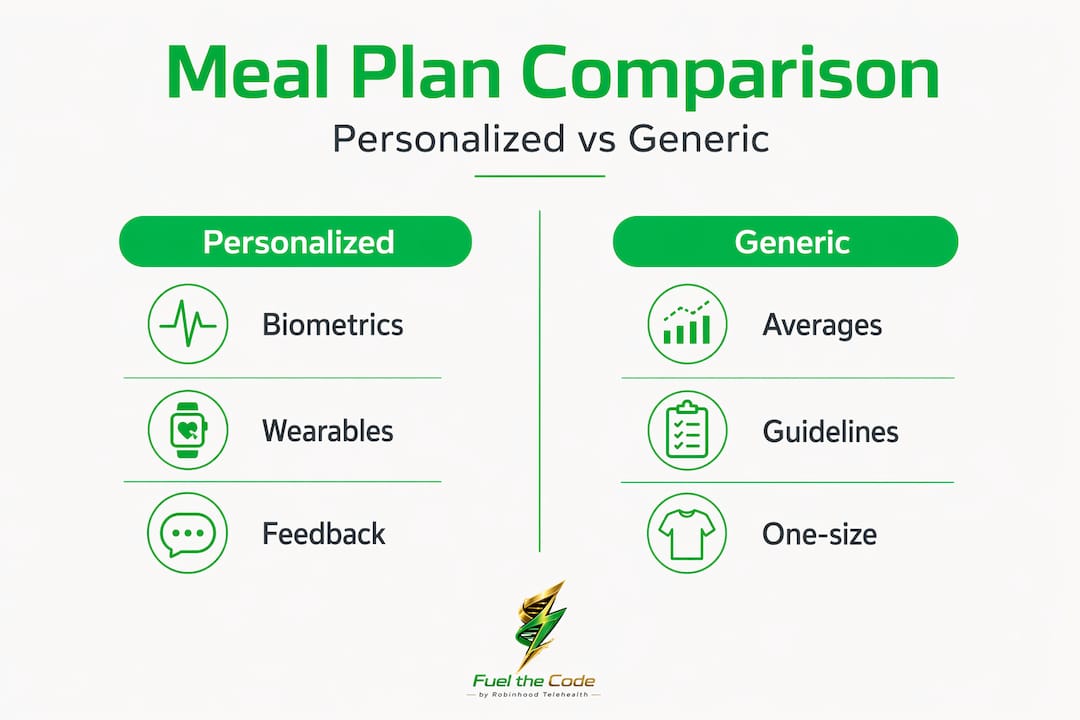
Generic dietary guidelines are built on population averages. They represent what works reasonably well across a large group, which means they are rarely optimal for any single person. Personalized meal plans flip that model entirely by starting with you: your biology, your behaviors, your environment, and your goals.
The data used to build a personalized plan can include anthropometric measurements like body composition and lean mass ratios, resting metabolic rate, genotype-phenotype patterns, food sensitivity markers, and even microbiome profiles. Rather than assigning the same macronutrient split to every athlete or every person managing blood sugar, personalized plans use individual-level inputs to generate recommendations that actually match how your body processes food.
This distinction matters more than most people realize. Two individuals with identical weight and activity levels can have dramatically different glycemic responses to the same meal. One person's triglycerides might spike after a high-fat breakfast while the other's remain flat. AI meal planning platforms are increasingly capable of modeling these differences at scale, making precision nutrition more accessible than it has ever been.
Generic vs. personalized plans: A direct comparison
| Feature | Generic diet plan | Personalized meal plan |
|---|---|---|
| Data basis | Population averages | Individual biomarkers and phenotype |
| Macronutrient ratios | Fixed or category-based | Adjusted by metabolism and goals |
| Glycemic response | Not accounted for | Modeled by CGM or biomarker data |
| Food preferences | Ignored or broad | Integrated with behavior data |
| Feedback loop | None | Continuous adjustment |
| Family applicability | Possible but imprecise | Scalable with family meal planning tools |
The practical advantages of this approach are significant:
- Metabolic alignment: Meals are timed and composed to match your individual energy usage patterns
- Reduced dietary fatigue: Plans that align with food preferences improve adherence significantly
- Faster feedback loops: You see measurable changes in energy, body composition, or bloodwork more quickly
- Goal specificity: Whether the target is body recomposition, longevity, or managing insulin resistance, the plan maps directly to that outcome
- Reduced trial and error: You spend less time experimenting with protocols that were never designed for your biology
How personalized nutrition works: Data, measurement, and feedback
With the contrast between generic and personalized plans established, let's look at the technology and methodology that makes individualization possible.

The most powerful personalized plans are not built on a single data point. They layer multiple streams of information to create a dynamic picture of how your body responds to food, stress, sleep, and physical output. CGM-based personalization can be operationalized through mechanistic loops such as continuous glucose monitor data and n-of-1 trial designs, where an individual acts as their own control group over time.
Here is how a robust personalized nutrition process typically unfolds:
- Baseline data collection: Blood panels, body composition scans, resting metabolic rate testing, and food intake logs establish your starting point
- Phenotype and genotype mapping: DNA methylation testing and metabolic phenotyping identify how your body processes specific macronutrients and micronutrients
- Dietary modeling: An algorithm or clinician builds a meal framework based on your individual data, including meal timing, food groups, calorie targets, and nutrient ratios
- Implementation with tracking: You follow the plan while tracking glucose via CGM, hunger signals, energy levels, and workout output using wearable sensors
- Feedback and iteration: Every two to four weeks, data is reviewed and the plan is refined based on real-world responses, not theoretical projections
- Long-term optimization: As your body adapts, goals shift, or biomarkers change, the plan evolves to stay ahead of your physiology rather than lagging behind it
Key data inputs in personalized nutrition
| Data type | Tool used | What it measures |
|---|---|---|
| Blood glucose dynamics | CGM | Glycemic response to specific foods |
| Body composition | DEXA scan or bioimpedance | Lean mass, fat mass, bone density |
| Hormonal markers | Blood panel | Insulin, cortisol, thyroid, testosterone |
| Genetic variants | DNA testing | Nutrient metabolism, lactate clearance |
| Microbiome profile | Stool analysis | Gut bacteria diversity and fermentation |
| Activity data | Wearable sensors | Caloric expenditure, recovery quality |
For people managing prediabetes or insulin resistance, this kind of precision is not just performance enhancement — it is clinical necessity. GLP-1 for prediabetes is one complementary tool gaining traction alongside personalized nutrition for metabolic reset.
Structured grocery list planners make the implementation phase much easier, translating abstract nutritional targets into actual food choices at the store.
Pro Tip: The most common reason personalized plans fail is not the data — it is the absence of a feedback loop. Schedule a formal plan review every three to four weeks, not just when something feels off. Proactive adjustment keeps your plan aligned with where your body actually is, not where it was six months ago.
Evidence and outcomes: Performance, metabolic health, and real-world impact
Understanding the mechanisms, it is crucial to look at what the research actually reveals about outcomes.
The evidence base for personalized nutrition has grown substantially. Randomized controlled trials consistently show that personalized nutrition approaches improved dietary quality and certain metabolic markers, including HbA1c, triglycerides, and insulin sensitivity, across multiple populations. These are not trivial improvements. HbA1c reduction translates directly to reduced diabetes risk. Improved triglyceride profiles reduce cardiovascular burden. Better insulin sensitivity supports body composition, cognitive function, and energy regulation.
For performance-focused individuals specifically, the benefits extend further:
- Lean mass preservation: Personalized protein targets protect muscle during caloric deficits more effectively than generic recommendations
- Training fuel optimization: Carbohydrate periodization matched to individual glycogen metabolism improves session output and recovery speed
- Hormonal stability: Micronutrient sufficiency, particularly zinc, magnesium, and vitamin D, supports testosterone and cortisol balance
- Reduced systemic inflammation: Anti-inflammatory food choices calibrated to individual inflammatory markers can accelerate recovery and reduce injury risk
- Gut health improvements: Fiber and prebiotic intake matched to microbiome profiles improves nutrient absorption and immune function
- Cognitive performance: Blood sugar stability, achieved through individualized meal timing, directly improves focus and decision-making under load
"Personalized nutrition research is moving from population-level dietary advice toward precision models that treat each individual as a unique biological system — with measurable, reproducible outcomes in metabolic and performance markers."
One particularly compelling area involves personalized metabolic health interventions that integrate meal planning with hormonal support. When nutrition is layered with peptide protocols, the combined effect on body recomposition and recovery markers often exceeds what either approach achieves independently.
It is worth noting that peptides and performance science is advancing rapidly alongside personalized nutrition, with overlapping mechanisms in growth hormone secretion, cellular repair, and inflammatory modulation. Understanding both gives you a more complete picture of what optimization actually looks like at a biological level.
The evidence does have limits, however. Some RCTs show only modest differences in weight loss between personalized and standard plans. Blood pressure improvements are inconsistent. These gaps are worth understanding honestly before you invest in any protocol.
Critical nuances and caveats: Evidence gaps and practical concerns
With the benefits covered, it is equally important to examine the challenges and nuances surrounding personalized nutrition.
One of the most significant problems in this space is definitional. The term "personalized nutrition" currently covers everything from a detailed genetic and CGM-driven protocol built with a clinician to a basic quiz-based app that adjusts calorie targets by age group. These are not the same thing, and conflating them distorts expectations. Evidence heterogeneity and bias in personalized nutrition trials remains a real concern, with inconsistency in outcome definitions and transparency across the research base.
Additional challenges include:
- Trial quality variation: Many studies use self-reported dietary data, which introduces significant measurement error
- Short follow-up windows: Few RCTs extend beyond 12 months, making long-term efficacy difficult to assess
- Placebo and attention effects: Participants who receive personalized feedback often eat better simply because they feel monitored, not because of the plan itself
- Access and cost barriers: Comprehensive genetic testing, CGM devices, and clinical support are not universally affordable
- Regulatory ambiguity: Precision nutrition frameworks acknowledge that scientific validation for many commercial tools remains limited, and oversight is still catching up with the market
- Microbiome science limitations: Despite excitement, translating microbiome data into reliable dietary prescriptions is still an early-stage application
The personalized nutrition debate among nutrition scientists is nuanced. Most experts agree the direction is right but caution against overpromising what current tools can reliably deliver.
Pro Tip: When evaluating any personalized nutrition service, ask three specific questions: What credentials do the clinicians or scientists behind the plan hold? What peer-reviewed data supports the biomarker tests used? And how is your personal health data stored and protected? If the answers are vague, treat the plan as commercial wellness rather than clinical precision medicine.
Sound healthy grocery tips built into a personalized plan can also reinforce behavior change at the point of purchase, which is often where adherence breaks down regardless of how sophisticated the underlying science is.
The real value of personalization: Beyond the hype
Here is the view we have formed from working at the intersection of clinical science and performance optimization: most people asking about personalized nutrition are actually asking the wrong question. The question is rarely "which biomarker test should I buy?" It is "how do I get a reliable feedback loop between what I eat and how I actually feel and perform?"
Personalization is not primarily a technology story. It is a behavioral change story that uses measurement as its mechanism. The CGM matters because it makes invisible processes visible. The DNA test matters because it gives you a starting hypothesis, not a final answer. What actually drives outcomes is the practice of observing, adjusting, and observing again. That discipline is available to anyone with basic tools and honest tracking, long before they invest in high-end genomics.
The contrarian take on gene-based diets specifically: genetics inform tendencies, not destinies. Someone with a variant associated with lower omega-3 metabolism does not simply need more fish oil. They need a systematic protocol that measures their actual response, adjusts intake, and re-tests. The gene data is the starting prompt, not the full answer.
AI-driven nutrition tools are genuinely useful when they serve that feedback loop rather than replacing clinical judgment. The risk is that technology creates an illusion of precision while bypassing the harder work of behavioral integration.
The most effective personalized plans we see are not the most technologically complex. They are the ones with the most consistent follow-through: weekly check-ins, honest food logging, and a willingness to change strategies based on actual results rather than attachment to a particular protocol. That mindset, combined with good clinical science, is where real performance gains live.
Take your next step with personalized nutrition
The science is clear: a nutrition strategy built around your biology, your goals, and your real-world data will consistently outperform a generic template. You already know that. The question is where to start.
Robinhood Telehealth brings together genetic testing, AI-driven meal planning, and clinician-guided premium peptide therapy into a single precision wellness platform. Whether you are targeting body recomposition, metabolic reset, or long-term longevity, our protocols are built on the same research principles covered in this article. Explore personalized meal plans, biomarker-informed supplement stacks, and telehealth consultations designed for performance-focused individuals who want science working in their favor, not against them.
Frequently asked questions
What data do personalized meal plans typically use?
Most plans use a mix of biometrics, food logs, metabolism data, and sometimes genotype or microbiome information to tailor recommendations to your individual biology and goals.
Do personalized meal plans improve weight loss over generic diets?
Some studies show personalized plans produce more weight loss, but between-group differences are often modest and not always consistent across populations or study designs.
How do digital tools like CGM help personalize nutrition?
CGM devices track glucose responses in real time, and wearable sensors enable dynamic dietary adjustments based on how your body actually reacts to specific meals, not how a population average would.
Are personalized meal plans safe and reliable?
Safety depends on credible data sources, qualified clinicians, and transparent data handling. Key safety concerns include test accuracy, expert credentials, and privacy protections, all areas where regulatory frameworks are still developing.
Does personalized nutrition always mean gene-based plans?
No. Experts emphasize that broader data integration across biomedical, behavioral, and environmental factors is essential, and genetic data alone is rarely sufficient for meaningful dietary personalization.