

Peptide therapy is one of the fastest-growing areas in performance medicine, yet most people entering this space are working from incomplete, inconsistent, or outright dangerous information. Online forums pass around dosing schedules and stacking strategies as if they were settled science, when the reality is far more complicated. The peptide landscape spans FDA-approved medications, gray-market research compounds, and everything in between. Whether you are pursuing recovery, body composition, hormonal balance, or longevity, the difference between benefit and harm often comes down to one thing: whether you are following a real protocol or just copying someone else's Reddit post.
Table of Contents
- What is a peptide protocol?
- Core components of peptide protocols
- Evidence, regulation, and safety concerns
- Applying peptide protocols: What works in practice
- The reality behind peptide protocols: What most guides get wrong
- Get expert support for your peptide journey
- Frequently asked questions
Key Takeaways
| Point | Details |
|---|---|
| Structured protocols matter | A peptide protocol should be a detailed, individualized plan for safe and effective use. |
| Not all peptides are equal | Some peptides are FDA-approved while many common protocols use unapproved, riskier products. |
| Start low and track | Expert consensus is to begin with low doses, adjust carefully, and monitor all effects. |
| Evidence is limited | Most popular dosing cycles lack strong clinical evidence—clinical supervision is critical. |
| Professional oversight essential | Safe, effective peptide use requires guidance from qualified healthcare providers. |
What is a peptide protocol?
A peptide protocol is not simply a list of compounds and doses. It is a structured, individualized framework that governs every decision from which peptide you select to how you track your body's response over time. According to Peptide Journal, a peptide protocol is a structured plan detailing the selection, dosing, timing, administration, tracking, and safety monitoring of peptides. That definition matters because it immediately separates a real protocol from the informal "cycles" most people encounter online.
Think of it like a clinical trial compressed into a personal health strategy. You are not just taking a compound. You are running an experiment on yourself, which means you need a hypothesis, a method, and a way to measure what is actually happening.
Here is what a legitimate peptide protocol includes:
- Peptide selection: Choosing the right compound based on your specific goal, health status, and existing medications
- Route of administration: Subcutaneous injection, intranasal spray, oral peptides, or topical application, each with different bioavailability profiles
- Dosing schedule: The amount per dose, frequency per day or week, and total duration of the protocol
- Cycle timing: When to start, when to pause, and how to structure on and off periods
- Tracking and logging: Documenting energy, sleep, body composition changes, and any side effects in real time
- Safety monitoring: Regular check-ins with a clinician, lab work, and awareness of contraindications
"A peptide protocol is a structured plan detailing the selection, dosing, timing, administration, tracking, and safety monitoring of peptides." — Peptide Journal
No two protocols look exactly the same. A 42-year-old endurance athlete pursuing mitochondrial support needs a completely different approach than a 35-year-old recovering from a soft tissue injury. Protocols are inherently personal, and that is precisely why copying someone else's approach is so problematic.
Core components of peptide protocols
With the definition established, the next step is understanding what actually goes into building and following a protocol. This is where most people skip critical steps, either because they are impatient or because they do not know what they do not know.
A common protocol workflow involves screening for contraindications, starting at a low dose, titrating carefully, and tracking effects meticulously. Here is how that breaks down in practice:
- Initial safety screening: Review your full medical history, current medications, and any conditions that could interact with peptide therapy. This is non-negotiable. Peptides affect signaling pathways that intersect with hormones, immune function, and metabolism.
- Peptide selection and sourcing: Choose based on evidence and regulatory status. Sourcing matters enormously. Pharmaceutical-grade compounds from compounding pharmacies under clinician supervision are fundamentally different from powders purchased online.
- Baseline labs: Get bloodwork done before you start. Hormone panels, metabolic markers, and inflammatory markers give you a real baseline to compare against.
- Low-dose initiation: Start well below the commonly cited dose. This is not timidity. It is how you identify your individual sensitivity before committing to a full protocol.
- Titration based on response: Increase dose gradually, watching for both desired effects and early warning signs of adverse reactions.
- Administration technique: Proper reconstitution of lyophilized peptides (freeze-dried powder form), sterile injection technique, and correct storage are all critical. Errors here can degrade the compound or introduce contamination.
- Ongoing monitoring and logging: Keep a daily or weekly log. Note sleep quality, energy levels, body weight, training performance, and any unusual symptoms.
- Cycling decisions: Many protocols include on/off periods, but the evidence base for specific cycling durations is thin for most peptides.
| Protocol component | Why it matters | Common mistake |
|---|---|---|
| Safety screening | Identifies contraindications early | Skipping it entirely |
| Sourcing | Determines purity and potency | Buying unverified online products |
| Baseline labs | Provides comparison data | Starting without any bloodwork |
| Dose titration | Reduces adverse event risk | Starting at maximum dose |
| Administration | Affects bioavailability and sterility | Improper reconstitution or storage |
| Logging | Enables protocol adjustments | Relying on memory alone |
Pro Tip: Keep a dedicated protocol journal, either a notebook or a simple spreadsheet, where you log dose, time, subjective effects, and any physical changes. This data becomes invaluable when adjusting your protocol or discussing progress with your clinician.
Cycling, specifically the practice of taking a peptide for a set number of weeks and then stopping for a period, is widely discussed but poorly supported by clinical research for most wellness-use peptides. Some practitioners recommend it to prevent receptor desensitization or to allow the body to recalibrate. Others argue it is unnecessary for peptides with short half-lives. The honest answer is that the evidence is not strong enough to make definitive claims either way.

Evidence, regulation, and safety concerns
This is where the conversation gets uncomfortable for a lot of people who are already deep into peptide use. The regulatory and evidence landscape is genuinely complicated, and most popular resources gloss over it.
Evidence and safety vary widely by peptide and product status. Many peptides used in wellness contexts are not FDA-approved. That does not automatically make them dangerous, but it does mean the safety and efficacy data are limited, inconsistent, or entirely absent.
Here is the critical distinction:
| Category | Examples | Regulatory status | Evidence level |
|---|---|---|---|
| FDA-approved peptides | Semaglutide, tesamorelin | Approved for specific indications | Clinical trials, post-market surveillance |
| Compounded peptides | Sermorelin, ipamorelin | Regulated through compounding pharmacies | Moderate, physician-supervised |
| Research-use peptides | BPC-157, TB-500 | Not approved for human use | Largely animal studies and anecdote |
The gray market for research peptides is enormous. These compounds are sold as "research use only," which is a legal designation that technically prohibits human use. In practice, many people purchase and self-administer them based on online community protocols. The risks here are real and underappreciated.
Key safety concerns include:
- Contamination: Unregulated products may contain bacterial endotoxins, heavy metals, or undisclosed compounds
- Mislabeling: Independent testing has repeatedly found that peptide products sold online do not match their labeled content in terms of purity or concentration
- Unknown long-term safety: Most wellness peptides have no human longitudinal data. You are not just experimenting on yourself short-term. You are accepting unknown long-term risk.
- Drug interactions: Peptides that affect growth hormone, insulin signaling, or immune pathways can interact with medications in ways that are not well characterized
- Absence of clinical dosing standards: No clinically validated or FDA-approved dosing regimen exists for BPC-157 or TB-500. Common cycles are based on anecdote rather than clinical evidence.
That last point deserves emphasis. BPC-157 and TB-500 are two of the most widely discussed peptides in athletic and recovery communities. The enthusiasm around them is significant. But the protocols circulating online, specific doses, injection frequencies, and stacking combinations, are built almost entirely on user reports and extrapolations from animal research. That is not a foundation for confident clinical use.
Stacking, the practice of combining multiple peptides simultaneously, amplifies all of these concerns. Each additional compound adds another layer of unknown interaction risk. The popular idea that more compounds equal more benefit is not supported by evidence and directly contradicts the basic pharmacological principle of minimizing variables.
Applying peptide protocols: What works in practice
Understanding the risks does not mean avoiding peptides altogether. It means approaching them with the discipline the evidence actually demands. Here is how to build a responsible protocol given real-world constraints.
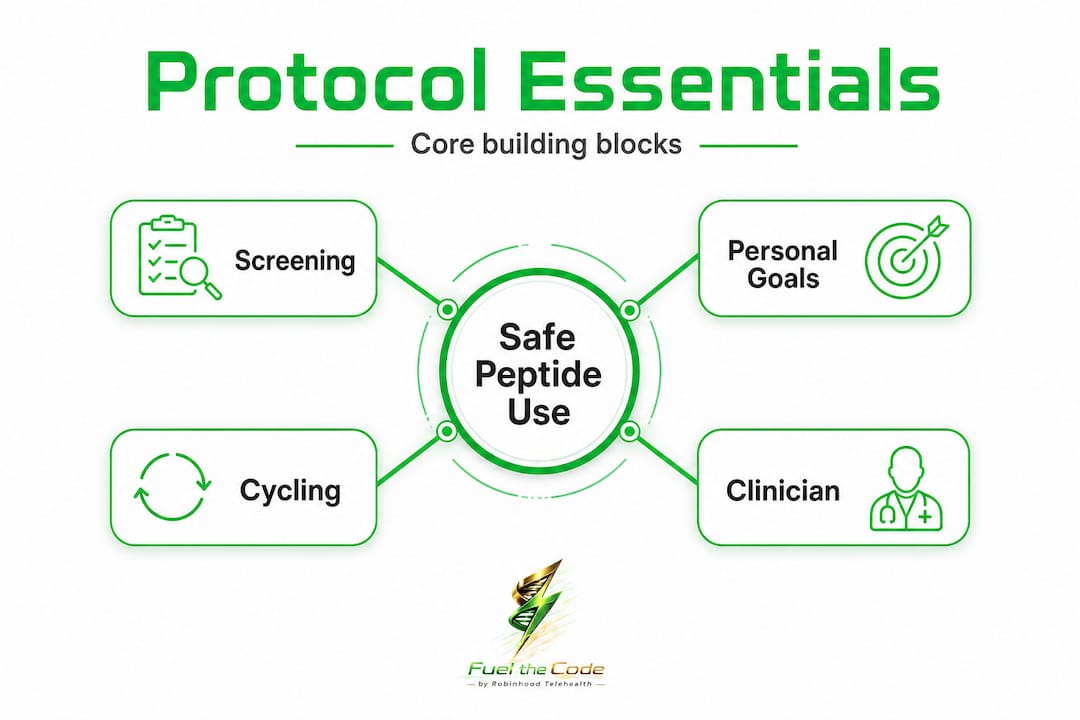
- Start with a clinician consultation: Before selecting any peptide, work with a licensed practitioner who specializes in peptide therapy or metabolic medicine. They can review your health history, order appropriate labs, and recommend compounds with a legitimate evidence base.
- Prioritize regulated options first: If your goal can be addressed by an FDA-approved or compounded peptide through a licensed pharmacy, start there. The safety profile is meaningfully better.
- Apply the start-low principle without exception: Start low and titrate, track everything, and understand that most cycling and stacking guidance lacks clinical validation. This is not optional. Individual variation in peptide response is significant.
- Maintain meticulous records: Log every dose, every subjective change, and every lab result. This is your safety net and your optimization tool simultaneously.
- Schedule regular clinical reviews: A protocol is not a set-and-forget system. Plan check-ins at four to six week intervals to review your logs, reassess labs, and adjust the approach.
- Resist stacking until you have a clear baseline: Run one peptide at a time until you understand how your body responds. Adding compounds before you have that data makes it impossible to attribute effects or side effects to any specific agent.
Pro Tip: If you are considering a peptide that is only available as a "research chemical," ask your clinician whether a compounded or approved alternative exists that targets the same pathway. Often, a safer option is available that simply requires a prescription.
The practical reality is that most people who pursue peptide therapy responsibly see meaningful results when they work within a structured, supervised framework. The ones who run into problems are almost always those who bypassed the clinical process in favor of speed and convenience.
The reality behind peptide protocols: What most guides get wrong
Here is the uncomfortable truth that most peptide content will not tell you directly: the confidence level in most online protocols is wildly disproportionate to the evidence supporting them.
Most consumer resources overstate the reliability of cycling and stacking guidance and downplay user safety risks. We see this pattern constantly. A forum post with thousands of upvotes recommending a specific BPC-157 protocol carries the social weight of clinical authority without any of the actual rigor.
Advanced users are not immune to this problem. In fact, experienced peptide users often carry the most dangerous blind spots. They have run multiple cycles without obvious adverse events, which they interpret as evidence of safety. But the absence of acute side effects is not the same as long-term safety, and it says nothing about the quality or purity of what they have actually been injecting.
The real issue is structural. Web communities are optimized for engagement, not accuracy. Protocols that produce dramatic short-term results get shared. Nuanced discussions about unknown long-term risks, contamination rates, or the absence of human clinical data do not generate the same enthusiasm. The result is an information environment that systematically overrepresents success stories and underrepresents risk.
What longevity and genuine performance optimization actually require is the opposite of that dynamic. They require caution, continuous oversight, and a willingness to update your approach based on emerging evidence rather than community consensus. The most sophisticated approach to peptide use is not the most aggressive one. It is the most informed one.
At Robinhood Telehealth, we have seen what happens when people come to us after years of self-directed peptide use without proper monitoring. The good news is that supervised protocols can often course-correct and optimize what someone has been doing. But the better path is always to start with proper oversight from day one.
Get expert support for your peptide journey
Peptide therapy works best when it is built on real clinical data, not forum consensus. The difference between a protocol that delivers lasting results and one that creates risk is almost always the presence of qualified oversight, proper sourcing, and ongoing monitoring.

At Robinhood Telehealth, our clinician-guided approach combines DNA testing, metabolic profiling, and evidence-based peptide selection to build protocols that are actually personalized to your biology. If you are ready to pursue premium peptide therapy with the kind of structured, supervised framework this article describes, our licensed practitioners are ready to help you build a protocol that is both effective and safe. This is precision wellness done right.
Frequently asked questions
Are peptide protocols safe for everyone?
No. Safety depends on screening and regulated supply chains, along with individual medical history and clinician supervision. Certain conditions, medications, and genetic factors can make specific peptides inappropriate or risky.
What's the difference between an FDA-approved peptide and a research peptide?
FDA approval status directly affects quality control, clinical evidence, and safety oversight. Research peptides sold online lack these protections and may carry contamination or mislabeling risks that approved compounds do not.
How long should a peptide protocol cycle last?
Common cycle durations of 8 to 12 weeks are not supported by controlled clinical evidence. Cycle length should be determined by a clinician based on your individual response, goals, and the specific compound being used.
Can I design my own peptide protocol safely?
Self-designed protocols carry significant risks because they lack the screening, sourcing oversight, and monitoring that clinician supervision provides. Working with a licensed practitioner dramatically reduces the chance of adverse outcomes while improving the precision and effectiveness of your protocol.