

You've probably seen peptides marketed as the next revolution in athletic performance, recovery, and body composition. The messaging is confident, the before-and-after photos are compelling, and the biochemistry sounds impressive. But here's what most fitness content won't tell you: the science behind peptide use is far more nuanced, far more individualized, and in many cases far less proven than the marketing suggests. This article separates what research actually shows from what's theorized, so you can make genuinely informed decisions about whether peptides belong in your performance strategy.
Table of Contents
- What are peptides and why are they used in fitness and medicine?
- Scientific evidence: What do we really know about peptides and performance?
- Peptide mechanisms: How do they (theoretically) enhance performance?-enhance-performance?)
- Risks and realities: Safety, regulation, and what most people miss
- Should you use peptides for performance? Practical and ethical considerations
- A truth most forget: Mechanism isn't outcome, and personalization is key
- Explore peptide therapy with expert guidance
- Frequently asked questions
Key Takeaways
| Point | Details |
|---|---|
| Evidence is limited | Most peptides have promising mechanisms but few direct human trials showing performance enhancement. |
| Safety matters most | Non-approved peptides can carry significant risks, especially with unsupervised or unverified use. |
| Mechanism isn’t outcome | Effects seen in lab models do not always translate into real athletic gains for healthy humans. |
| Personalization is key | Medical guidance and individualized approach are crucial for safe and effective peptide use. |
What are peptides and why are they used in fitness and medicine?
Peptides are short chains of amino acids, typically fewer than 50 residues, that sit between individual amino acids and full-length proteins in terms of size and complexity. Your body already produces thousands of peptides naturally. Many function as signaling molecules, hormones, or cellular messengers. Insulin is a peptide. So is glucagon. Growth hormone-releasing hormone is a peptide. These molecules are already running essential biological processes 24 hours a day.
The fitness and wellness world became excited about peptides because some of them appear to influence processes that athletes care deeply about: muscle repair, fat metabolism, collagen synthesis, and inflammation control. Synthetic or concentrated versions of these molecules, or analogs that mimic their action, became attractive tools for people who wanted to optimize those same processes intentionally.
Common peptide categories you'll encounter in performance and recovery contexts include:
- Growth hormone secretagogues such as Ipamorelin and CJC-1295, which stimulate the pituitary gland to release more growth hormone
- BPC-157, a synthetic pentadecapeptide derived from a protective gastric protein, promoted heavily for tendon and ligament healing
- MOTS-c, a mitochondria-derived microprotein with proposed roles in metabolic regulation and insulin sensitivity
- Collagen peptides, oral supplements derived from hydrolyzed collagen used to support connective tissue and joint health
- TB-500, a synthetic fragment of thymosin beta-4 with proposed roles in tissue repair and angiogenesis (growth of new blood vessels)
What these peptides share is the ability to interact with specific receptors or pathways in ways that, at least theoretically, modulate energy metabolism, muscle cell signaling, and tissue repair. That theoretical appeal is exactly why athletes, biohackers, and clinicians alike have taken notice. The question is whether that appeal holds up under scientific scrutiny.
Scientific evidence: What do we really know about peptides and performance?
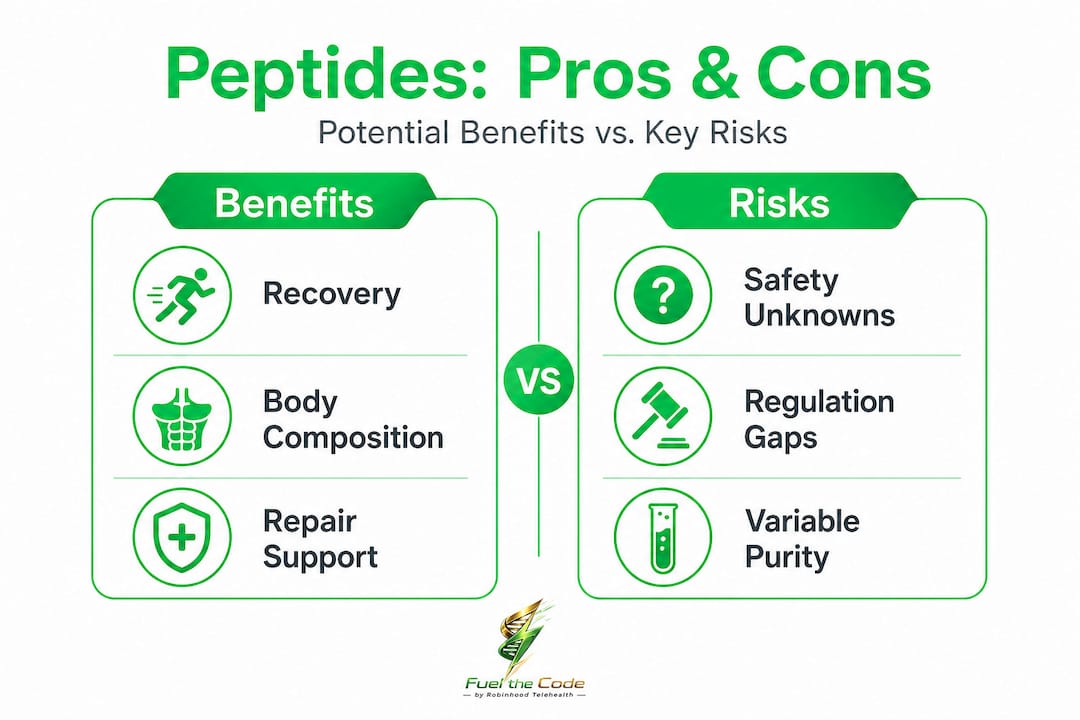
Understanding why peptides are intriguing is the easy part. The harder question is what controlled research actually demonstrates when you move from theory to human trials.

The honest answer: the evidence base is highly uneven. Some peptides have solid mechanistic data from cell cultures and animal models. Human clinical data is sparse for most, nonexistent for some, and only moderately convincing for a handful. There is currently no high-quality clinical evidence in human subjects supporting BPC-157 for performance or recovery, and the broader peptide expansion has significantly outpaced peer-reviewed evidence.
Here's a comparison of evidence quality for the most popular performance peptides:
| Peptide | Animal evidence | Human evidence | What's actually measured |
|---|---|---|---|
| BPC-157 | Strong | None published | Wound healing, tendon repair in rats |
| MOTS-c | Moderate | Very limited | Metabolic signaling, insulin sensitivity |
| Collagen peptides | N/A | Moderate | Amino acid availability, joint symptoms |
| CJC-1295/Ipamorelin | Moderate | Minimal | GH pulse frequency, IGF-1 levels |
| TB-500 | Limited | None | Angiogenesis, tissue migration |
One finding worth paying close attention to involves collagen peptides specifically. While they do increase circulating amino acids following resistance exercise, collagen peptides do not further increase myofibrillar protein synthesis rates in healthy, recreationally active people. That's a critical distinction. Raising amino acid levels in the blood is a surrogate endpoint. Actually building more contractile muscle protein is the outcome that matters for strength and hypertrophy. The two don't always correlate.
Most performance peptide studies measure surrogate markers: hormone levels, biomarkers, imaging findings. Far fewer measure what athletes actually care about: strength output, sprint times, recovery speed, or endurance capacity. Surrogate data can point in an interesting direction, but it isn't proof of performance enhancement.
This gap between surrogate endpoints and true performance metrics is one of the most important concepts to internalize before spending money or taking risks on a peptide protocol. When a study shows that a compound raises IGF-1 levels, it doesn't automatically follow that your bench press will improve or your recovery time will shorten. Human physiology is considerably more complicated than a single biomarker.
Considering individualized peptide therapy with clinical guidance is one way to contextualize biomarker data within your actual physiology rather than relying on generic protocols designed for average populations.
Peptide mechanisms: How do they (theoretically) enhance performance?
To understand what peptides could realistically do, you need to look at the specific cellular pathways they're proposed to influence. This isn't just academic. Understanding mechanisms helps you evaluate claims critically and ask better questions.
| Peptide | Proposed pathway | Animal outcome observed | Human evidence status |
|---|---|---|---|
| MOTS-c | AMPK activation, mitochondrial signaling | Improved insulin sensitivity, reduced fat mass in obese mice | Not established in athletic humans |
| BPC-157 | Angiogenesis, nitric oxide signaling | Accelerated tendon repair in rat models | No RCTs in humans |
| CJC-1295 | GHRH receptor agonism | Increased GH secretion | GH pulse data in small trials only |
| Collagen peptides | Proline/hydroxyproline delivery | Increased collagen synthesis markers | Modest joint symptom improvement |
| TB-500 | Actin sequestration, cell migration | Wound closure acceleration in animal models | No controlled human trials |
MOTS-c is a fascinating example of how far the gap between mechanism and measurable outcome can be. It's described as an exercise mimetic with metabolic signaling effects, meaning it activates some of the same cellular machinery that exercise activates. Preclinical studies in mice show real metabolic changes. But translation to measurable athletic performance in humans has not been established. Activating a pathway and improving sprint times are two very different things.
The importance of safety in peptide research methodology also can't be overstated here. How a peptide is prepared, stored, and administered dramatically affects both its activity and its safety profile. Solutions that aren't sterile or correctly reconstituted can cause infection or tissue damage entirely independent of the peptide itself.
Pro Tip: Mechanistic plausibility is genuinely exciting science. But it doesn't automatically translate to real-world performance gains. Before investing in any peptide protocol, look specifically for direct outcome studies in humans, not just animal pathway data or surrogate biomarker improvements.
Risks and realities: Safety, regulation, and what most people miss
Mechanism and theory are only part of the picture. The practical landscape of peptide use involves serious regulatory gaps, quality control concerns, and safety uncertainties that most marketing materials never address.
Here's what you genuinely need to understand:
- Regulatory status matters enormously. Many injectable peptides are not FDA-approved and may have uncertain safety profiles, unpredictable dosing, and no mandated quality controls. This isn't a technicality. It has direct consequences for what you're actually injecting.
- Quality control is a serious issue. Gray-market peptides sold as "research chemicals" are not manufactured under pharmaceutical standards. Independent testing has found contaminants, incorrect concentrations, and even completely wrong compounds in batches labeled as specific peptides.
- Immune reactions are possible. Injecting novel proteins or protein fragments carries a risk of triggering immune responses, from local site reactions to systemic inflammatory responses. The risk profile is not fully characterized for most performance peptides.
- Long-term effects are unknown. Nearly all the safety data that exists covers short-term use. The effects of sustained use over months or years haven't been studied in any rigorous way.
- Hormonal disruption is a concern. Peptides that influence growth hormone or other hormonal axes can alter feedback loops in ways that may not be immediately apparent but could affect endocrine health over time.
The distinction between compound classes is also relevant. Peptides that are prescribed FDA-approved medications (like certain GLP-1 receptor agonists used for metabolic health) go through completely different processes than performance-marketed injectables sold online.
Critically, following sterile peptide practices matters as much as the compound itself. Reconstitution errors, improper storage, and non-sterile technique can cause harm that has nothing to do with the peptide's biological activity.
Pro Tip: Never approach injectable peptides as a self-service supplement. The administration route alone (subcutaneous or intramuscular injection) requires proper technique. Only consider peptide therapy with a knowledgeable clinician who can verify sourcing, confirm appropriate application, and monitor your response.
Should you use peptides for performance? Practical and ethical considerations
For those genuinely curious about whether peptides belong in their health strategy, a structured evaluation framework is far more useful than a blanket yes or no. Here's a step-by-step approach:
-
Clarify your specific goal. Are you trying to accelerate injury recovery, improve body composition, enhance metabolic health, or optimize hormonal balance? Different peptides are proposed to influence different outcomes. Matching mechanism to goal is the first filter.
-
Evaluate the evidence standard. Look for human clinical trials that measure the outcome you care about, not just animal data or mechanistic studies. If no human evidence exists, your risk-benefit calculation should reflect that uncertainty directly.
-
Confirm legal and regulatory status. In competitive sports, many peptides are prohibited by the World Anti-Doping Agency even when they're not illegal to possess. Understand where the peptide falls under both sports rules and local law.
-
Secure medical supervision before starting. A clinician can assess whether your specific physiology, health history, and goals make a particular peptide appropriate. They can also monitor labs to detect unintended effects early.
-
Verify sourcing and quality. If a clinician is prescribing a compounded peptide, confirm that the pharmacy is accredited. If you're considering anything purchased online, be aware that quality is essentially unverifiable without independent testing.
-
Reassess periodically. Peptide protocols aren't set-and-forget. Ongoing monitoring, lab work, and outcome tracking are essential to understand whether you're actually achieving results or simply spending money on a theoretical mechanism.
This structured approach reflects the core principle that FDA-approved peptide drugs and unapproved peptides used for performance enhancement operate in fundamentally different regulatory and evidence environments. Personalized medicine done right requires that distinction to be central to every decision.
Working with a clinician who specializes in individualized peptide medicine means that your protocol is built around your biology, your goals, and verified evidence rather than marketing claims.
A truth most forget: Mechanism isn't outcome, and personalization is key
Here's a perspective you won't find in supplement ads or biohacking forums: the performance peptide space has a reproducible pattern of exciting mechanism, weak human outcome data, and enormous commercial momentum that runs far ahead of the science. It's not fraud exactly. It's something subtler and harder to resist. Researchers observe a fascinating pathway activation in preclinical work, enthusiasts extrapolate that to athletic benefit, and a market forms before the rigorous outcome studies exist to validate or refute the extrapolation.
Even experienced clinicians can be pulled in by mechanistic plausibility. When you understand exactly how a compound theoretically increases angiogenesis or activates AMPK, it feels credible. The mechanism makes sense. The biology is coherent. But as the research consistently shows, mechanistic plausibility is far more common than performance proof. The distance between "this pathway is activated" and "you will recover faster and perform better" is vast, and human physiology fills that distance with unpredictable complexity.
The antidote isn't skepticism for its own sake. It's demanding outcome-based evidence and seeking genuine personalization. Your genetic profile, baseline hormone levels, training load, and recovery capacity all influence whether a given peptide will do anything meaningful for you specifically. What shows a modest effect at the population level in a small study may be irrelevant to your individual biology.
That's why personalization driven by actual diagnostics, not just symptom reporting, is the most honest and effective framework for anyone exploring peptide therapy. The goal shouldn't be to follow a protocol because it worked for someone on a forum. It should be to build a strategy that accounts for your unique physiological context and is monitored rigorously enough to detect real outcomes.
Explore peptide therapy with expert guidance
If this article has given you a clearer picture of where the science stands, you're already thinking about peptides the right way: with curiosity balanced by healthy scrutiny.

At Robinhood Telehealth, we approach peptide therapy through the lens of clinical precision, not trend-chasing. Our licensed practitioners combine genetic testing, methylation analysis, and biomarker data to build protocols grounded in your actual physiology. If you're ready to move past the marketing and explore what evidence-based, clinician-supervised peptide support could look like for your goals, premium peptide therapy options are available through our telehealth platform. We believe that your biology deserves better than generic protocols, and we're equipped to deliver exactly that.
Frequently asked questions
Are peptides safe for enhancing athletic performance?
Many injectable peptides are not FDA-approved, may lack proper dosing data, and can pose safety risks if not medically supervised. The lack of regulatory oversight for most performance-focused peptides means quality and safety cannot be assumed.
Do collagen peptides help build muscle if I work out?
Collagen peptides increase amino acid availability in the blood, but myofibrillar protein synthesis rates are not further elevated in healthy, recreationally active adults. They support connective tissue but are not equivalent to whey or other protein sources for muscle building.
What is the main difference between FDA-approved and non-approved peptides?
FDA-approved peptides have undergone controlled clinical trials and are manufactured under regulated standards, while unapproved performance peptides lack that evidence base and regulatory oversight entirely.
Can peptides replace exercise or proper nutrition?
No compound currently has strong human evidence supporting its use as a substitute for structured training and adequate nutrition. MOTS-c is called an exercise mimetic, but its metabolic effects in preclinical studies have not translated into proven human athletic performance improvements.
How can I ensure peptide safety if I'm interested in therapy?
Work exclusively with a licensed clinician, use only verified pharmaceutical-grade or compounded peptides from accredited pharmacies, and insist on ongoing lab monitoring. The absence of FDA approval for most performance peptides makes medical supervision non-negotiable, not optional.