

Most people hear "meal planning" and picture a rigid diet with color-coded containers and zero wiggle room. That framing is wrong, and it's exactly why so many well-intentioned nutrition efforts fail within weeks. What is individualized meal planning, then? It's the practice of building a nutrition strategy around your unique biology, schedule, and goals rather than borrowing a template designed for the average person. Your genetics, blood markers, metabolism, and daily habits all factor in. The result is a plan that fits your actual life.
Table of Contents
- What is individualized meal planning and why does it matter?
- How individualized meal plans are created: the step-by-step process
- Flexibility and adaptability: keys to long-term success with your meal plan
- Common pitfalls and expert strategies in individualized meal planning
- A fresh perspective: why viewing meal plans as living documents changes everything
- Get personalized support with expert coaching and tailored meal plans
- Frequently asked questions
Key Takeaways
| Point | Details |
|---|---|
| Tailored nutrition | Individualized meal planning uses your unique biology and lifestyle to create a personalized nutrition strategy. |
| Stepwise creation | Effective plans follow a structured process from goal setting to recipe choice to weekly review. |
| Flexibility matters | Viewing your meal plan as adaptable helps maintain consistency and long-term adherence. |
| Avoid common pitfalls | Auditing pantry and using core meals prevent wasted effort and make planning more sustainable. |
| Plans evolve | Adjust your plan based on progress and life changes to keep improving your health outcomes. |
What is individualized meal planning and why does it matter?
Individualized meal planning, often called precision nutrition, uses your unique biological and behavioral data to build dietary recommendations that genuinely work for you. Generic diets assign the same calorie targets and food lists to everyone, ignoring the fact that two people eating identical meals can have dramatically different outcomes in blood sugar, body composition, and energy.
The science here is well established. Personalized nutrition integrates your genetics, metabolic responses, and lifestyle data into tailored dietary recommendations. That means factors like your gut microbiome, inflammatory markers, fasting glucose, and even sleep quality can directly shape what you eat and when.
What gets incorporated into a truly individualized plan includes:
- Genetic variants that affect nutrient metabolism, such as how efficiently you process saturated fat or absorb folate
- Blood biomarkers including glucose, cholesterol, triglycerides, and hormone panels
- Metabolic rate and body composition data that determines real caloric need
- Lifestyle variables like training schedule, work stress, sleep duration, and cooking capacity
- Food preferences and cultural background to make adherence realistic
Using biological data for meal plans is no longer reserved for elite athletes or clinical patients. AI-driven platforms and telehealth services now make this level of personalization accessible, and the performance gains are measurable. You recover faster from training, sustain energy more consistently, and avoid the metabolic drag that comes from eating for someone else's body type.
How individualized meal plans are created: the step-by-step process
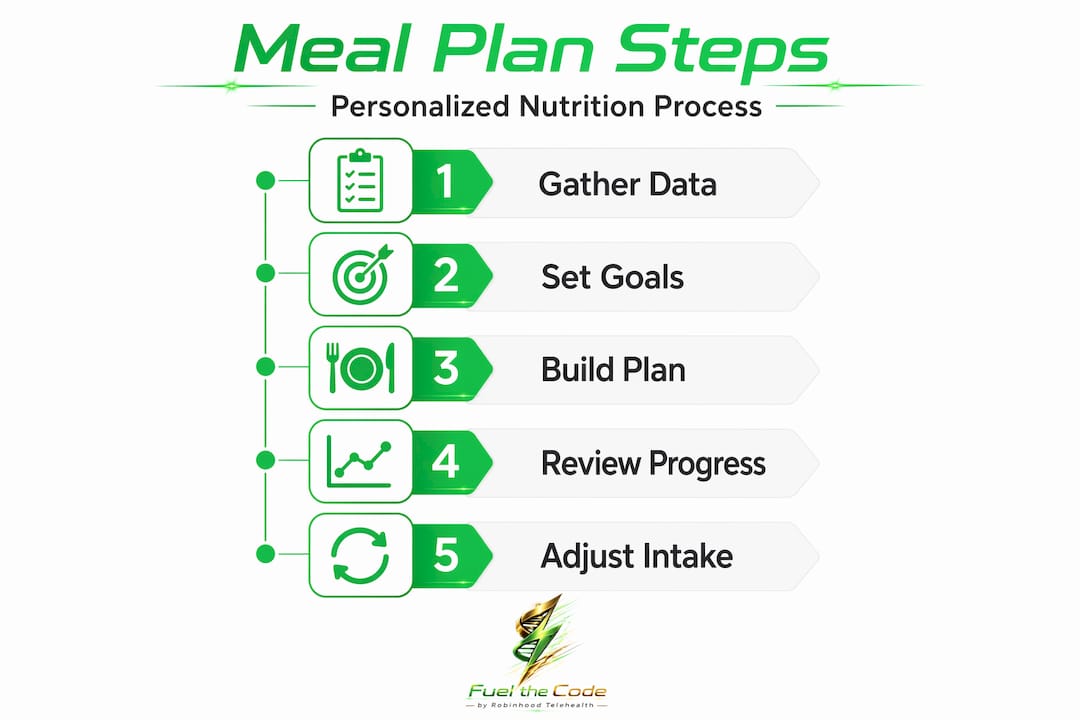
With the basics defined, here's how an individualized meal plan is carefully crafted to fit you. The process is more structured than most people realize, and cutting corners at any step is why self-built plans often stall.
Experts recommend a 6-step process covering goals, schedule audit, recipe selection, leftover strategy, grocery list creation, and weekly reviews. Here's what that looks like in practice:
- Set specific nutrition targets. Calculate your actual calorie and protein needs based on your goals, body composition, and activity level. "Eat more protein" is not a target. A concrete range like 165 to 185 grams of protein per day is.
- Audit your current schedule and energy levels. Identify which days you have time to cook and which days you need meals that take under 15 minutes. A Tuesday that ends with a 7 p.m. training session calls for something completely different than a slow Sunday morning.
- Choose recipes that match your real cooking skills. Not your aspirational cooking skills. If you're a beginner, a four-component stir-fry beats a 12-ingredient grain bowl every time, especially when consistency matters more than variety.
- Build a leftover strategy. Plan intentionally to double a dinner recipe so it covers lunch the next day. This single habit cuts your weekly cooking time roughly in half without reducing nutrition quality.
- Create a unified grocery list. Pull all ingredients across every planned meal into one organized list. Missed items mid-week are a top reason people abandon plans and default to takeout.
- Run a short weekly review. Spend 10 minutes assessing what worked, what you skipped, and what needs adjustment. This keeps your plan calibrated rather than stale.
Coaches can spend 45 to 90 minutes creating plans manually, but the right software slashes that time while adding data points no human can track alone.
Pro Tip: Before building any new plan, photograph your fridge, freezer, and pantry. This single audit prevents duplicate purchases and reveals what's already available to build meals around, which reduces both food waste and grocery spending.
Nutrition planning for families adds another layer. Flexible family meal planning requires balancing individual needs within a shared meal structure, and creating efficient grocery lists is one of the highest-impact habits you can build regardless of household size.

Flexibility and adaptability: keys to long-term success with your meal plan
Understanding the creation process sets the stage for how to keep your meal plan effective through life's ups and downs. The single biggest predictor of success is not how perfectly calibrated your macros are. It's whether you can sustain the plan across months and years.
Consistency, not culinary perfection, is the primary driver of long-term results with any meal plan. A plan you follow 85 percent of the time for a year beats a perfect plan followed for three weeks.
"Successful clients view their plan as a dynamic roadmap, adjusting for life obstacles like travel or stress." Precision Nutrition's coaching philosophy
Individual diet plans that account for real behavioral signals outperform those that ignore them. Ignoring psycho-behavioral signatures like your stress levels or emotional relationship with food reduces plan success, regardless of how accurate the macros are. That's not a soft claim, it's a structural weakness in any nutrition strategy that treats you like a metabolic machine rather than a whole person.
Practical flexibility looks like this in action:
- Travel weeks get simplified templates, such as high-protein hotel-friendly meals, rather than full abandonment of the plan
- Social events get pre-planned buffers in the form of a slightly lower-calorie morning meal rather than avoidance
- High-stress periods trigger a shift to simpler, lower-prep options rather than forcing complex recipes that compound stress
- Progress plateaus signal a caloric or macro adjustment, not a failure requiring a restart
Pro Tip: When you notice your weight has stalled for two or more weeks, adjust your intake by 150 to 200 calories in either direction before assuming the plan has failed. Most plateaus resolve with minor recalibration, not complete overhauls.
Meal plan flexibility tips apply across contexts, whether you're managing a demanding training block, a work deadline, or a family obligation. The plan bends. You don't break.
Common pitfalls and expert strategies in individualized meal planning
With flexibility and behavioral insights in mind, let's explore common mistakes to avoid and expert tips for success. Knowing why people fail is more useful than generic advice about why people succeed.
Pitfall 1: Starting without a pantry audit. Failing to audit your pantry before you begin leads to wasted money and mid-week gaps that derail the whole week.
Pitfall 2: Building a new recipe every single night. Novelty feels motivating at first, but it creates unsustainable prep demands. The fix is a structured rotation.
Successful plans use a "core meal" approach with reusable dinners, intentional leftovers, and at least one flexible open night per week. A common version of this is the 3-1-1 method:
- Three fully planned and cooked dinners per week
- One leftover night using dinner from the night before
- One completely flexible night requiring no planning or prep
Pitfall 3: Ignoring progress signals. Weight loss plateaus or too-rapid loss are signals to adjust energy intake by 100 to 200 calories, not reasons to quit or start over.
Here's a quick comparison of rigid versus adaptive planning approaches:
| Feature | Rigid meal plan | Adaptive individualized plan |
|---|---|---|
| Response to travel | Plan collapses | Simplified template activates |
| Response to plateau | Panic or abandonment | Caloric adjustment of 100 to 200 kcal |
| Recipe variety | Fixed and unchanging | Rotated by preference and season |
| Review frequency | Never | Weekly short check, monthly targets |
| Stress management | Ignored | Built into plan design |
Pro Tip: When avoiding common meal planning mistakes, the most impactful single habit is a 10-minute Friday review. Look at the week ahead, check what's in your kitchen, and pre-decide your three core meals. Decisions made in advance under low stress are always better than reactive ones made hungry on a Tuesday night.
A fresh perspective: why viewing meal plans as living documents changes everything
Here's the argument most nutrition content avoids making: the entire concept of a "meal plan" has been framed wrong from the start.
The word "plan" implies something fixed, finished, and handed to you. Follow the plan. Stick to the plan. The language of restriction is baked directly into the framing. But the most effective individual diet plans work more like operating systems than instruction manuals. They update. They respond to new data. They get smarter over time.
Adaptive Personalized Nutrition Advice Systems blend biomedical, behavioral, and environmental data to create truly dynamic and personalized plans. That's not a future technology. It's available now through platforms that combine AI with real-time tracking and clinical oversight.
What changes when you adopt this framing is your relationship with deviation. A meal you didn't plan for a Friday dinner is no longer a failure. It's a data point. You log it, you note how it affected your energy or sleep, and you adjust. The plan absorbs the information and improves. That mental shift from "I broke my diet" to "I generated useful feedback" has a larger impact on long-term adherence than almost any nutritional tweak.
The other shift worth making is recognizing that precision nutrition is not just about food. It's about the intersection between what you eat, how your body processes it, and how your behavior either supports or undermines that biology. Adaptive nutrition technology makes this intersection visible and actionable, which is exactly where the real performance gains live.
Generic meal plans are not the problem. Static thinking is.
Get personalized support with expert coaching and tailored meal plans
To make your individualized meal planning journey even easier, consider personalized support from experts who understand your unique needs. Knowing the framework is useful. Having it built specifically for your biology, goals, and schedule is another level entirely.
Robinhood Telehealth combines AI-driven meal planning with genetic and biomarker testing to create nutrition strategies that actually match how your body works. Whether you're chasing performance gains, faster recovery, or long-term metabolic health, the platform pairs tailored meal options with clinician-guided protocols to accelerate your results. Their premium peptide therapy services and custom nutrition plans are designed to work together, addressing the hormonal, metabolic, and dietary variables that generic approaches miss entirely. If you're serious about getting more from your nutrition, this is where science meets strategy.
Frequently asked questions
What makes a meal plan truly individualized?
A truly individualized meal plan is built on your genetic, metabolic, and lifestyle data rather than population-level averages, which is what makes its outcomes meaningfully different from generic nutrition guides.
How often should individualized meal plans be adjusted?
Weekly short checks and monthly adjustments keep your plan aligned with actual progress, catching small deviations before they compound into bigger setbacks.
Can individualized meal plans work for people with busy lifestyles?
Yes, because they're specifically designed around your schedule, including recipes that match your cooking capacity and built-in flexibility for days when preparation time is minimal.
Is flexibility important in an individualized meal plan?
Flexibility is not optional. Viewing plans as dynamic roadmaps rather than fixed rules is what separates people who sustain results for years from those who reset every few months.