

Not all peptides are created equal, and the wellness industry's tendency to treat them as one unified category causes real harm. The role of peptides in longevity is far more layered than most articles let on. Some are FDA-approved medicines with large-scale trial data. Others are experimental compounds with no human dosing guidelines whatsoever. Understanding which is which, and why the distinction matters, is the difference between a protocol that supports your healthspan and one that puts you at unnecessary risk.
Table of Contents
- Key takeaways
- The role of peptides in longevity, explained
- Peptide classes and evidence tiers
- Why the evidence gaps actually matter
- How to integrate peptide therapy practically
- The future of peptides and aging science
- My honest take on navigating the peptide space
- How Robinhoodtelehealth approaches peptide therapy
- FAQ
Key takeaways
| Point | Details |
|---|---|
| Peptides target multiple aging pathways | They influence metabolism, telomere biology, cell repair, and mitochondrial function simultaneously. |
| Evidence tiers vary dramatically | FDA-approved peptides like tirzepatide have robust trial data; many others have only animal or cell-study support. |
| DIY peptide use carries real risk | Without medical oversight, dosing uncertainty and product purity issues create significant safety concerns. |
| Supervision changes the equation | Clinician-guided protocols reduce risk and help you match the right peptide to your biology and goals. |
| Peptides work best in context | They are one component of a longevity strategy, not a standalone fix for aging. |
The role of peptides in longevity, explained
Peptides are short chains of amino acids, typically between 2 and 50 units long. Think of them as molecular messengers: precise, targeted, and capable of triggering very specific biological responses. Hormones like insulin are peptides. So are growth factors, immune regulators, and a growing class of therapeutics designed to intervene in aging processes at the cellular level.
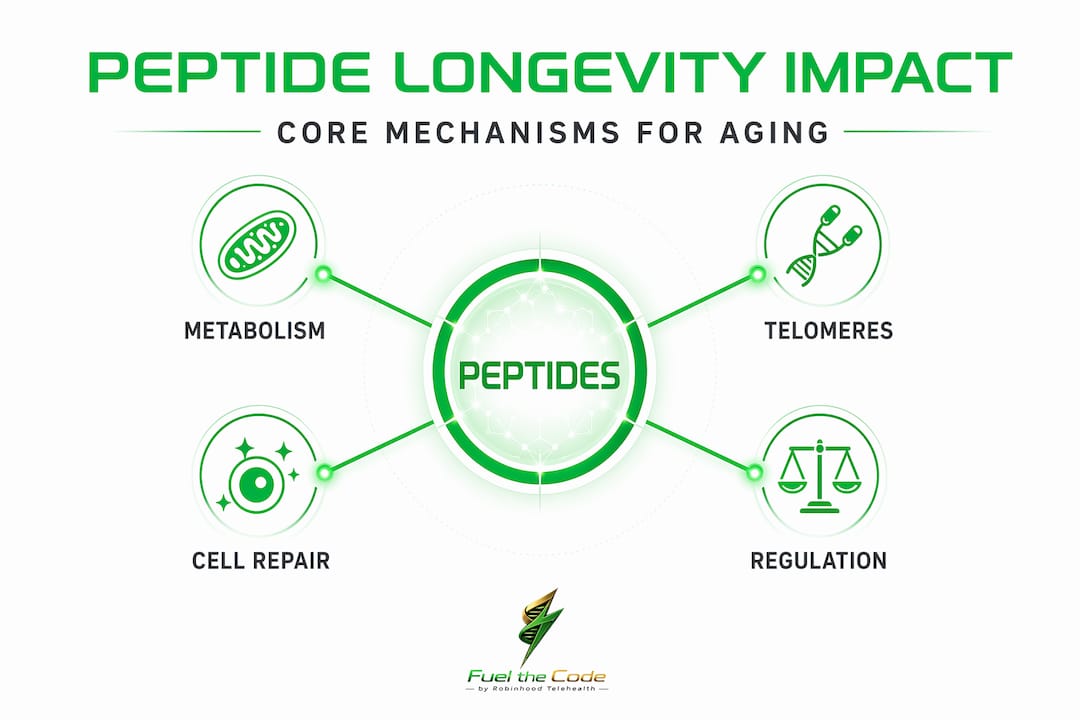
The reason peptides matter for longevity is that aging is not one problem. It is many simultaneous failures. Researchers have identified nine core "hallmarks" of aging, including genomic instability, telomere shortening, mitochondrial dysfunction, and cellular senescence. Therapeutic peptides target all nine of these hallmarks through different mechanisms, making them uniquely positioned as multi-pathway interventions.
Here is what makes them biologically distinctive:
- Metabolic regulation: Peptides like GLP-1 agonists improve insulin sensitivity, reduce visceral fat, and lower systemic inflammation, all of which accelerate aging when dysregulated.
- Cell repair and proteostasis: Certain peptides stimulate the clearance of damaged proteins and promote tissue regeneration after injury or cellular stress.
- Hormone modulation: Growth hormone-releasing peptides signal the pituitary to produce more GH, which declines significantly after age 30, contributing to muscle loss and metabolic slowdown.
- Mitochondrial support: Peptides like MOTS-c activate AMPK pathways to enhance oxidative stress resistance and metabolic efficiency, extending healthspan in animal models.
- Telomere biology: Some peptides directly influence telomerase activity, the enzyme that protects the ends of chromosomes from deterioration.
Pro Tip: When evaluating any peptide for longevity use, ask specifically which hallmark of aging it targets and what tier of evidence supports it. "Anti-aging" as a category tells you nothing useful.
Peptide classes and evidence tiers
Understanding the diverse peptide mechanisms in play requires sorting them by both mechanism and clinical validation. Here is how the major categories stack up:
| Peptide | Primary target | Evidence tier | Regulatory status |
|---|---|---|---|
| Tirzepatide | Metabolic/GLP-1 + GIP | Large RCTs | FDA-approved |
| Epitalon | Telomere/circadian | Animal + small human studies | Investigational |
| GHK-Cu | Dermal/gene expression | In vitro + animal | Cosmetic/research use |
| BPC-157 | Tissue repair | Animal models | Not approved |
| CJC-1295/Ipamorelin | GH modulation | Small human trials | Research only |
| Semax | Neuroprotection | Limited human studies | Approved in Russia |
| MOTS-c | Mitochondrial/AMPK | Animal models | Experimental |
The gap between the top and bottom of that table is enormous. Tirzepatide has proven effects on glycemic control and significant weight reduction in clinical trials involving thousands of patients. Epitalon shows interesting results, including lifespan extension of 12% to 24% in rodent models, along with telomere-lengthening effects in cell studies. But there are no large, controlled human trials behind it.
GHK-Cu is another example worth understanding. Its levels drop dramatically with age, and laboratory studies show it modulates gene expression consistent with younger cellular profiles. Compelling biology. But whether topical or injectable GHK-Cu actually reverses aging in humans, at what dose, and with what long-term safety profile, that remains an open question with no definitive answer.

Pro Tip: Start with peptides that have the most clinical data. Tirzepatide and other GLP-1 class agents give you metabolic benefits with a known safety profile. Build from there rather than jumping straight to experimental compounds.
Why the evidence gaps actually matter
This is where most wellness content fails you. Plausible biology does not equal proven benefit. A peptide that activates a relevant pathway in a rat or in a petri dish may behave completely differently in a living human body, especially over months or years of use.
Many wellness peptides have limited human trial data, meaning GHK-Cu, BPC-157, and TB-500 all rely primarily on animal or small uncontrolled human studies. This does not make them worthless. It makes them experimental, and the difference matters when you are the one injecting them.
Specific risks include:
- Dosing uncertainty: Experts warn against improvised dosing because effective and safe concentrations are often unknown for non-approved peptides.
- Cancer risk with GH-related peptides: Growth hormone promotes cell growth broadly, not selectively. Theoretical cancer risk from GH-stimulating peptides is real and underappreciated in most marketing.
- Product purity: Research peptides purchased outside medical channels may contain contaminants or incorrect concentrations, creating unpredictable effects.
- No long-term safety data: Even if a peptide appears safe at six weeks, nobody knows what happens at six years.
"Peptides are not interchangeable. Quality, dosing, and administration route critically affect both potency and safety. The biggest risk is people treating research-grade compounds as if they were regulated medicines." — Expert perspective cited by NPR
The disconnect between peptide marketing and actual regulation is significant. Many compounds sold as "longevity peptides" are not regulated as drugs. That means no manufacturing standards, no dosing requirements, and no post-market safety tracking. These are not small oversights.
How to integrate peptide therapy practically
If you are serious about using peptides for longevity, the path forward involves structure, not experimentation. Here is a practical framework:
- Start with metabolic foundations. GLP-1 receptor agonists like tirzepatide have the strongest clinical backing for addressing age-associated metabolic dysfunction, including insulin resistance and weight management. This is your most defensible starting point.
- Get clinician oversight before anything else. A licensed practitioner can assess your baseline metabolic markers, hormone levels, and health history before recommending a peptide protocol. This is not optional. It is what separates therapy from guessing.
- Source from regulated providers. Compounding pharmacies and telehealth platforms operating under physician supervision provide far more quality assurance than online peptide vendors. You can review what safe peptide protocol use actually looks like before you commit to anything.
- Ask specific questions. What is the mechanism? What is the human evidence? What are the known side effects? What monitoring is recommended? If a provider cannot answer these, that tells you something.
- Combine peptides with lifestyle inputs. Sleep, resistance training, stress management, and nutrition are not optional add-ons. They are the environment that determines whether a peptide protocol produces results.
- Track markers, not feelings. Biological age tests, methylation panels, and metabolic labs give you objective data on whether an intervention is working. Subjective energy improvements can be placebo. Numbers do not lie.
Pro Tip: A DNA methylation test before starting a peptide protocol gives you a biological age baseline. That way you can measure whether your protocol is actually moving the needle, not just whether you feel better.
The future of peptides and aging science
The science is moving fast, and the near-term outlook is genuinely promising. The multi-pathway targeting capacity of peptides gives them an advantage over single-mechanism drugs when it comes to aging, which is a multi-factorial process.
| Research direction | Key mechanism | Current stage |
|---|---|---|
| Mitochondrial peptides (MOTS-c, humanin) | AMPK activation, oxidative defense | Animal models, early human trials |
| Epigenetic peptides | Methylation pattern normalization | Preclinical |
| Senolytic peptides | Clearance of senescent cells | Investigational |
| Combined GLP-1 class agents | Metabolic + cardiovascular protection | Ongoing large trials |
Short peptides encoded in both nuclear and mitochondrial genomes regulate aging hallmarks with exceptional specificity. This specificity is exactly what long-term longevity medicine needs. The challenge is translating that specificity from animal models to reliable human protocols with known safety windows.
What remains unresolved includes optimal combination strategies, long-term effects of stacking multiple peptides, and the question of whether benefits seen in animal aging studies will translate proportionally to human healthspan. These gaps are not reasons to dismiss peptides. They are reasons to demand rigor from the providers and protocols you choose.
My honest take on navigating the peptide space
I have seen enough of this space to know that the hype cycle around peptides moves faster than the science does. Biologically plausible mechanisms get turned into marketing copy before there is a single human dose-response study. I find this genuinely frustrating, not because peptides are without merit, but because the overclaiming poisons the well for the interventions that actually have solid backing.
What I have learned is this: the people who benefit most from peptide therapy are not the ones who chase the newest compound. They are the ones who build their protocol on metabolic fundamentals first, get appropriate testing done, and work with clinicians who can read a lab report. The investigational compounds are interesting. The FDA-approved metabolic agents with years of trial data are where real, defensible longevity benefit lives right now.
Peptides are a legitimate tool. They are not a shortcut, and they are certainly not a replacement for the basics. Treat them as precision instruments in a broader strategy, and they earn their place. Treat them as magic bullets, and you are taking on risk you probably have not fully calculated.
— G
How Robinhoodtelehealth approaches peptide therapy

At Robinhoodtelehealth, the approach to peptide therapy starts with your biology, not a generic protocol. Clinician-guided assessments, methylation testing, and genetic data inform which interventions actually fit your metabolic profile. That means no guessing on dosing and no sourcing from unverified channels.
The platform's peptide and GLP-1 protocols are built around evidence-tiered options, including GLP-1 class agents with full clinical backing, alongside carefully supervised investigational peptide options for those who qualify. Every protocol includes clinician oversight, quality-verified sourcing, and ongoing monitoring so you can see objective results in your lab markers, not just subjective reports.
If you are ready to move from researching peptides to using them with real clinical support, Robinhoodtelehealth makes that step structured, safe, and measurable.
FAQ
What is the role of peptides in longevity?
Peptides act as molecular messengers that target multiple biological hallmarks of aging simultaneously, including telomere attrition, mitochondrial dysfunction, and metabolic decline. Their ability to intervene across several aging pathways at once makes them uniquely suited to longevity medicine.
Which peptide therapies have the strongest evidence?
FDA-approved metabolic peptides like tirzepatide have the strongest clinical trial evidence, with proven benefits for glycemic control and weight management. Most other longevity-focused peptides remain investigational, supported mainly by animal or small human studies.
Is peptide therapy for longevity safe?
Safety depends entirely on the specific peptide, dosing accuracy, product quality, and medical supervision. Clinician-guided protocols using regulated compounds carry far lower risk than DIY use of research-grade peptides with unknown concentration and purity.
How do peptides influence lifespan at the cellular level?
Peptides like epitalon activate telomerase to lengthen telomeres, while mitochondrial peptides like MOTS-c activate AMPK to improve cellular energy metabolism and oxidative stress resistance. These mechanisms directly address two of the core drivers of cellular aging.
Do I need a prescription to use peptide therapy?
FDA-approved peptides require a prescription. Many investigational peptides are sold as "research chemicals" without regulatory oversight, which creates significant safety and quality risks. Working with a licensed telehealth provider is the safest way to access and use peptide protocols.