

Peptide therapy has moved from niche sports medicine circles into mainstream wellness conversations, and the noise can be deafening. Everyone from elite athletes to weekend warriors is talking about growth hormone secretagogues, GLP-1 receptor agonists, and tissue-repair peptides like BPC-157. But the market has expanded far faster than the science, leaving most people unable to separate genuine clinical value from marketing hype. This guide cuts through that confusion by explaining exactly what peptide therapy is, how it works mechanistically, where the real evidence stands, and what you need to know before ever considering it yourself.
Table of Contents
- Understanding peptide therapy: What are peptides?
- How peptide therapy works in your body
- Approved medical peptide therapies vs. unregulated peptides
- Human evidence, hype, and what to watch for
- Safety, sourcing, and finding reliable peptide therapy
- Why the real value of peptide therapy isn't just about the trend
- Explore medically guided peptide therapy options
- Frequently asked questions
Key Takeaways
| Point | Details |
|---|---|
| Peptide therapy basics | Peptide therapy uses short amino acid chains to target specific biological pathways for health, recovery, or performance. |
| Approved vs. unapproved products | FDA-approved peptide therapies have rigorous evidence and monitoring, while unregulated products carry safety risks. |
| Evidence quality varies | Many fitness and wellness peptides lack robust human data, even if mechanisms sound promising. |
| Personal safety matters | Proper sourcing and clinical supervision are critical for minimizing risk with peptide therapy. |
| Smart choices are key | Investing in programs with professional medical oversight provides safer, more effective results. |
Understanding peptide therapy: What are peptides?
With the confusion surrounding peptide therapy, let's start by defining exactly what peptides are and how they function in your body.
Peptide therapy is the medical or research use of peptides, which are short chains of amino acids, to target specific biological pathways and physiological processes. Think of them as molecular messengers. Your body already produces thousands of peptides naturally, including insulin, oxytocin, and glucagon. Peptide therapy either supplements those natural signals or introduces synthetic analogs designed to produce a specific biological effect.
Peptides sit in a fascinating pharmacologic middle ground. They are larger and more structurally specific than small-molecule drugs like aspirin, but far smaller and less complex than full protein biologics like monoclonal antibodies. This size difference has real-world consequences: peptides can be highly specific in their receptor targeting, but they are often fragile, degrade quickly in the gut (which is why many require injection), and can have unpredictable effects when used outside clinical settings.
Here is a quick comparison of the three categories:
| Feature | Peptide | Protein biologic | Small-molecule drug |
|---|---|---|---|
| Size | 2 to 50 amino acids | 50 to thousands of amino acids | Single molecule |
| Specificity | High | Very high | Moderate |
| Delivery route | Often injectable | Injectable | Oral or injectable |
| Regulatory status | Mixed | Mostly approved | Mostly approved |
| Stability | Low to moderate | Low | High |
Common applications of peptide therapy in medicine and fitness include:
- Metabolic and endocrine regulation: GLP-1 agonists for blood sugar control and weight management
- Growth hormone axis: Secretagogues that stimulate natural growth hormone release
- Immune modulation: Peptides designed to regulate inflammatory response
- Tissue repair and recovery: Peptides promoted for wound healing and injury recovery
- Cardiovascular health: Peptides targeting blood pressure and arterial function
The peptide drug pipeline has surpassed 60 approved therapies globally, with the most growth concentrated in metabolic and endocrine indications. This is not a fringe category; it's a mature and expanding area of pharmaceutical science.
The key takeaway here is that peptides are not exotic or experimental by definition. Many are clinically validated and prescribed daily. The controversy arises when unapproved peptides enter the wellness space without that same level of rigor.
How peptide therapy works in your body
Now that you understand what peptides are, it's important to see how peptide therapy actually influences your body on a molecular level.
Peptides work primarily as signaling molecules. They bind to specific receptors on cell surfaces, much like a key fitting into a lock, and trigger a cascade of downstream biological events. That receptor specificity is what makes peptide therapy exciting: a well-designed peptide can activate one pathway without broadly disrupting your entire endocrine or metabolic system the way some traditional drugs do.

Therapeutic peptides often act as receptor agonists, meaning they stimulate the same receptor that a natural hormone or signaling molecule would. Some act as antagonists, blocking a receptor to suppress an unwanted response. Others work through more complex mechanisms involving intracellular signaling cascades.
Key signaling pathways commonly targeted by peptide therapy include:
- GLP-1 receptor pathway: Regulates insulin secretion, gastric emptying, and appetite. This is the pathway targeted by drugs like semaglutide.
- Growth hormone releasing hormone (GHRH) pathway: Stimulates pituitary release of growth hormone, affecting body composition and recovery.
- Ghrelin receptor pathway: Influences hunger signaling and growth hormone release simultaneously.
- Melanocortin receptor pathway: Implicated in fat metabolism, sexual function, and inflammation.
- mTOR and IGF-1 signaling: Critical for muscle protein synthesis and cellular growth responses.
Understanding these pathways matters because the specificity that makes peptides promising also makes them nuanced to use. A peptide targeting one receptor can produce dramatically different effects depending on tissue type, dosing, and timing.
Pro Tip: The same mechanistic specificity that gives peptides their advantage also means side effects can be precise and unexpected. A peptide that stimulates growth hormone release, for example, might also affect cortisol regulation, water retention, or insulin sensitivity in ways that vary significantly between individuals.
Not all peptide interventions are equal in quality of evidence, even among those with clear mechanisms. Strong mechanistic data does not automatically translate into predictable clinical outcomes, especially in healthy individuals trying to optimize performance rather than treat disease.
Approved medical peptide therapies vs. unregulated peptides
Not all peptides used in wellness are the same, which brings us to a critical distinction that impacts both safety and results.
The FDA has approved peptide drugs that have gone through rigorous clinical trials, established dosing protocols, and long-term safety monitoring. These include GLP-1 agonists for diabetes and obesity, growth hormone formulations for deficiency, and several peptide hormones used in endocrinology and oncology. When you use an FDA-approved peptide under medical supervision, you benefit from standardized manufacturing quality, known pharmacokinetics, and an established safety profile.
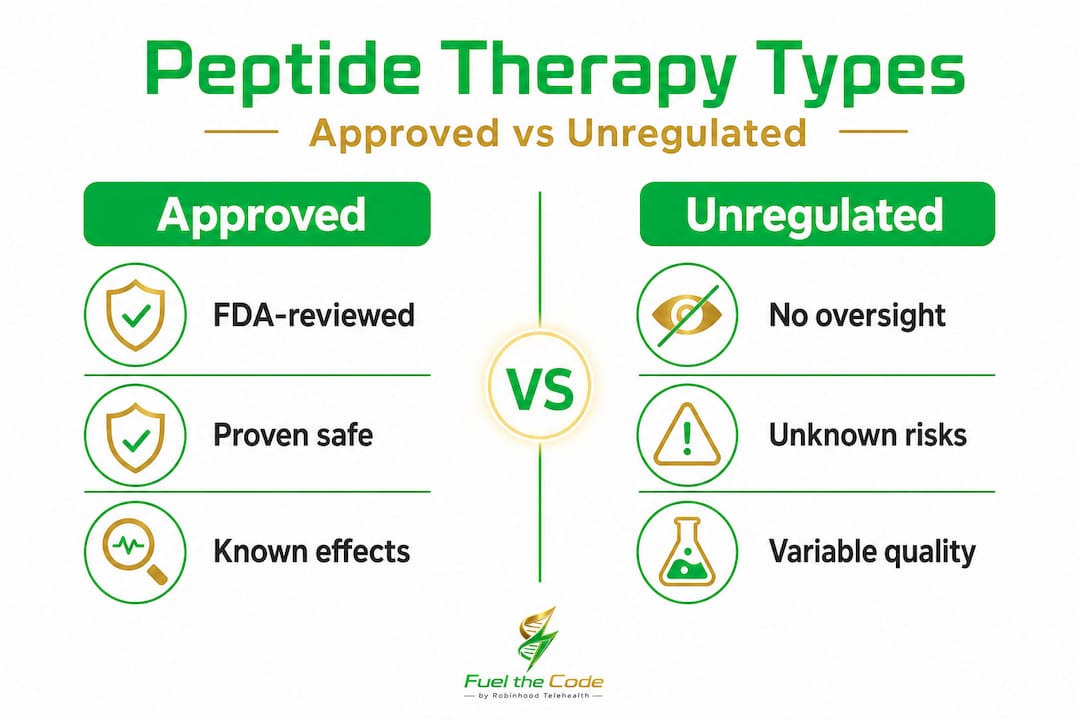
The gray market is a different story entirely. There is a major distinction between FDA-approved peptide drugs and the expanding range of unapproved peptides marketed for fitness and recovery. These products are often sold as "research chemicals," a label that technically exempts them from certain regulations while signaling that they are not intended for human use. In practice, many consumers inject them anyway.
Here is a direct comparison to understand the risk landscape:
| Factor | FDA-approved peptide | Gray market peptide |
|---|---|---|
| Clinical trial data | Required | Usually absent |
| Manufacturing standards | GMP certified | Unknown |
| Dosing guidance | Established | Anecdotal |
| Side effect profile | Known | Largely unknown |
| Contamination risk | Low | High |
| Medical supervision | Standard | Rare |
Before trying any form of peptide therapy, check for the following:
- Regulatory status: Is the peptide FDA-approved for your intended use, or is it an unapproved analog?
- Prescribing physician: Is a licensed clinician overseeing your protocol and monitoring your labs?
- Supply chain transparency: Can you verify the manufacturer and batch testing?
- Evidence base: Are there peer-reviewed human trials, or only animal studies and forum testimonials?
- Interaction risk: Have you disclosed all current medications and health conditions to a provider?
Understanding safe peptide protocols before starting any therapy is not optional; it's the baseline. The GLP-1 evidence base represents what rigorous clinical development looks like, and it's a useful benchmark when evaluating claims made about less-studied peptides. For a broader overview, reviewing approved vs. unregulated peptide products can help you develop a sharper eye for the differences in quality and regulation.
Human evidence, hype, and what to watch for
Understanding the difference between approved and unregulated peptides reveals why claims around performance and recovery often sound better than the evidence supports.
The fitness industry has embraced peptide therapy with remarkable enthusiasm, and the social media ecosystem around it has amplified that enthusiasm well beyond what the science justifies. Human evidence for many wellness peptides lags far behind mechanistic or animal data, and the criticism is mounting for peptides like BPC-157, where human evidence is extremely limited despite widespread use.
BPC-157 is a peptide derived from a protein found in gastric juice. Animal studies have shown promising effects on tissue healing, gut health, and even neurological protection. The fitness community has turned those animal findings into confident claims about injury recovery, tendon healing, and gut repair. The problem is that human trials for BPC-157 are nearly nonexistent. We simply do not know if it works in humans the way it appears to work in rodents, and more importantly, we do not know how it interacts with long-term human physiology.
Common pitfalls and traps to watch for as a consumer:
- Animal-to-human extrapolation: A peptide that heals tendons in mice does not automatically do the same in a 200-pound athlete
- Dosing from forums: Community-driven dosing is rarely based on pharmacokinetic data
- Placebo-driven results: Recovery-focused individuals may experience improvements from lifestyle changes and belief alone
- Confirmation bias in testimonials: People who see results share; people who don't often go silent
- Stacking without data: Combining multiple unapproved peptides creates interaction risks that no existing study has evaluated
Additionally, athletic peptide research increasingly calls for more rigorous human trials and better regulatory frameworks before clinical recommendations can be made. The gap between what's claimed online and what the evidence supports is significant, and it's growing.
Pro Tip: When evaluating a peptide's evidence, search for human randomized controlled trials on PubMed, not just mechanistic studies or animal research. If you find fewer than five solid human studies, treat the evidence as preliminary and proceed with significant caution.
Understanding proper use and best practices for any peptide protocol is the minimum standard you should hold yourself to before engaging with this category.
Safety, sourcing, and finding reliable peptide therapy
So, how can you maximize benefits and minimize risk if you're considering peptide therapy for wellness or fitness?
The risk landscape is not just pharmacological. Clinicians emphasize that concerns include not only the pharmacology of specific peptides but also product quality and regulatory oversight for unapproved peptides marketed online. Verified supply chains and appropriate patient selection are foundational requirements, not optional extras.
Counterfeit and contaminated peptides are a genuine public health concern. Independent testing of gray market peptides has revealed products with incorrect concentrations, bacterial contamination, and completely absent active ingredients. When you inject a product purchased from an unverified source, you are taking on compounded risks: the known risks of the peptide itself, plus unknown risks from whatever else may be in the vial.
Steps to take before starting any peptide therapy:
- Consult a licensed clinician who specializes in peptide therapy or endocrinology and can evaluate your health history
- Get baseline labs including hormone panels, metabolic markers, and relevant biomarkers specific to the peptide you're considering
- Verify the peptide's regulatory status and whether it is prescribed versus purchased from an unregulated source
- Confirm the pharmacy or compounding facility is licensed and follows Good Manufacturing Practice (GMP) standards
- Start low and monitor with regular follow-up appointments and lab checks to catch any adverse response early
- Avoid stacking unproven peptides until individual responses are well understood
For guidance on medical peptide protocols built on clinical oversight, that is where any serious conversation should start. If cost is a factor, exploring safe sourcing for peptides through legitimate channels with transparent pricing and verified pharmacies is a responsible middle path.
Why the real value of peptide therapy isn't just about the trend
Having clarified how to approach peptide therapy safely, it's time for a candid look at what actually matters versus what's just marketing noise.
Here's our honest perspective: the cultural fascination with peptide therapy has created a performance optimization arms race that is, in many cases, working against the people participating in it. Most people chasing peptides are already training, eating, sleeping, and recovering reasonably well. The marginal benefit of an unproven peptide protocol, relative to the risk, is almost never worth the cost, especially when the "evidence" is primarily anecdote.
What we see consistently is that the individuals who benefit most from clinically guided peptide therapy are those with a genuine hormonal deficit, a metabolic condition, or a documented recovery challenge that standard approaches have failed to address. GLP-1 agonists for people with insulin resistance and obesity. Growth hormone secretagogues for adults with documented deficiency. These are appropriate, evidence-backed applications with meaningful clinical outcomes.
The uncomfortable truth is that most peptide-related improvements reported on social media are probably a combination of placebo response, lifestyle improvement, and the general motivation boost that comes from investing money and attention in your health. That's not nothing, but it's not what's being sold.
What actually works in the long run is rigorous diagnostics, personalized protocols built on your actual biomarker data, and ongoing clinical monitoring. The future of peptide therapy is moving toward exactly that: personalized protocols driven by genetic data, methylation testing, and metabolic panels, overseen by clinicians who can adjust based on real-world response. That's the direction worth following.
Slowing down, consulting professionals, and embracing honest skepticism about marketing claims will serve you better than any unproven stack. Exploring real-world safety tips grounded in clinical experience is where this journey should actually begin.
Explore medically guided peptide therapy options
If peptide therapy seems right for you, taking the next step with reliable guidance is crucial.
The difference between a transformative outcome and a dangerous experiment often comes down to who is guiding your protocol and how it's being monitored. At Robinhood Telehealth, clinician-guided peptide protocols are built around your actual biology, using DNA testing, methylation analysis, and metabolic biomarkers to personalize every recommendation.

Whether you're exploring peptide therapy for metabolic health, recovery optimization, or hormone balance, you deserve a science-first approach that prioritizes your safety. With premium peptide therapy options available through licensed practitioners, telehealth consultations, and verified supply chains, Robinhood Telehealth puts clinical rigor at the center of every protocol. Start with the diagnostics, get the guidance, and build your strategy on real evidence.
Frequently asked questions
What is the main difference between peptides and proteins?
Peptides are short amino acid chains of typically 2 to 50 units, while proteins are larger, more complex molecules made from one or more long peptide chains folded into three-dimensional structures. The size difference affects how they're processed, absorbed, and used therapeutically.
Are there FDA-approved peptide drugs?
Yes, the number of approved peptide drugs has surpassed 60 globally, with strong representation in endocrinology, metabolic disease, and oncology. Many of these are in regular clinical use and have established long-term safety data.
Is peptide therapy safe for general wellness or fitness use?
Safety depends heavily on the specific peptide, its source, and whether it's being used under medical supervision. Unapproved peptides sold online carry elevated risks from impurities, incorrect dosing, and the complete absence of clinical oversight.
Do all fitness peptides have strong evidence they work?
No. Human evidence for BPC-157 and several other popular fitness peptides is extremely limited, with most claims based on animal studies or anecdotal reports rather than randomized controlled human trials.
What should I look for when choosing a peptide therapy?
Prioritize expert clinical supervision, regulatory approval where available, and a verified peptide supply chain. Avoid gray market products with no manufacturing transparency, unknown purity, and no prescribing clinician involved in your care.