

Most people who follow biohacking protocols think they understand peptides. They've stacked BPC-157, researched CJC-1295, or tracked GLP-1 analogs. But there's a meaningful gap between the peptides you encounter in supplement catalogs and the molecules your body actually synthesizes to keep you alive. Physiologic peptides are naturally occurring molecules00063-5) made by the body that participate in normal signaling and regulation, and confusing them with every product labeled "peptide" can cost you both results and safety. This guide separates the science from the noise so you can make smarter decisions.
Table of Contents
- Defining physiologic peptides: What makes them unique?
- How physiologic peptides work: The science of signaling
- Peptides and biohacking: Evidence, limits, and misconceptions
- Peptides, aging, and the future: Research frontiers
- Why understanding physiologic peptides matters more than ever
- Explore responsible peptide therapy with Robinhood Telehealth
- Frequently asked questions
Key Takeaways
| Point | Details |
|---|---|
| Definition matters | Physiologic peptides are natural signaling molecules produced by your body—not just any peptide supplement. |
| Function through precision | These peptides work by targeting specific receptors and precisely controlling critical body processes. |
| Evidence is selective | Only certain peptides, like those modeled after physiologic hormones, have robust scientific support for human health. |
| Biohacking caution | Not all claims about peptide supplements are backed by science; some benefits remain investigational. |
| Longevity potential | Research into peptides and aging is promising but not yet conclusive for human longevity optimization. |
Defining physiologic peptides: What makes them unique?
A peptide is simply a chain of amino acids shorter than a full protein, typically fewer than 50 residues, though the exact cutoff varies by context. What makes a peptide physiologic is its origin and purpose: your body produces it, releases it in a regulated way, and uses it to send precise biological messages. Not every peptide you consume or inject qualifies.
Peptide hormones are small, low-abundance bioactive molecules00063-5) under 100 amino acids that participate in fundamental processes like metabolism, growth, reproduction, and homeostasis. They're not static molecules sitting in storage. They're dynamic signals released in pulses, often measured in picograms per milliliter of blood, and they carry outsized biological authority relative to their size.

The phrase "peptides" functions as a broad chemical category, while "physiologic peptides" refers specifically to endogenous peptides with defined roles in normal signaling. That distinction matters enormously for biohackers who want to know whether a product can actually interact with the body's native communication networks.
Here's a quick comparison to anchor your thinking:
| Feature | Physiologic (endogenous) peptides | Exogenous or synthetic peptides |
|---|---|---|
| Origin | Produced by your own cells | Synthesized in a lab |
| Regulation | Pulsatile, context-dependent | Fixed dose, no feedback loop |
| Receptor fit | Evolved for native receptors | Variable receptor affinity |
| Degradation | Enzymatically controlled | Often resists normal clearance |
| Evidence | Extensive human data | Mostly preclinical or anecdotal |
Some of the most studied physiologic peptides include:
- Insulin: Regulates glucose uptake and energy storage across nearly every tissue
- Glucagon: Counterbalances insulin, mobilizing glucose from liver glycogen
- GLP-1 (glucagon-like peptide-1): Manages satiety signaling and incretin-driven insulin release
- GH (growth hormone): Drives tissue repair, fat mobilization, and anabolic signaling
- Oxytocin: Coordinates social bonding, stress responses, and uterine function
- ANP (atrial natriuretic peptide): Regulates blood pressure and sodium balance
Pro Tip: When evaluating any peptide product, ask whether its amino acid sequence and release kinetics actually match what your body produces endogenously. Many products use modified sequences designed for stability but with fundamentally different receptor behavior.
How physiologic peptides work: The science of signaling
With a working definition in hand, let's explore what actually happens in your body when a physiologic peptide is released. The process is more elegant and more complex than most biohacking content describes.
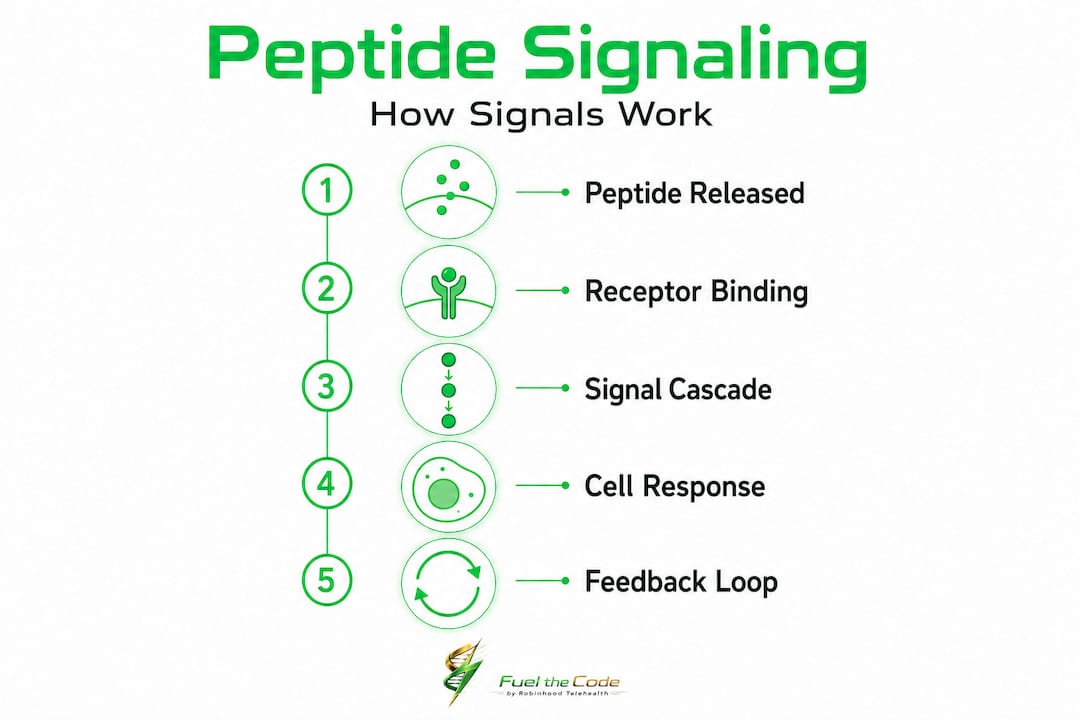
Peptide hormones act by binding specific cell-surface receptors and triggering intracellular signaling cascades, often through G-protein coupled receptors (GPCRs) and second messengers like cyclic AMP and calcium. Because peptides are water-soluble, they can't cross the cell membrane directly. Instead, they land on a receptor on the cell surface and hand off their message like a key turning a lock.
Here's how the full signaling sequence typically plays out:
- Synthesis: A specialized cell, often in the brain, gut, or endocrine gland, transcribes and translates a precursor protein that gets cleaved into the active peptide.
- Storage and release: The peptide is packaged into vesicles and released in response to a specific trigger, such as blood glucose rising, physical stress, or a neural signal.
- Circulation: The peptide travels through blood or interstitial fluid to reach target tissues, often degrading quickly (half-lives range from seconds to minutes for many peptide hormones).
- Receptor binding: The peptide docks onto a specific cell-surface receptor with high specificity. A mismatch in sequence or conformation means no signal.
- Intracellular cascade: Receptor activation triggers second messengers that amplify the signal inside the cell, modifying enzyme activity, gene expression, or ion transport.
- Termination: Enzymes like DPP-4 break down the peptide, and receptor internalization "resets" the system, preventing overstimulation.
"Peptide hormone signal transduction requires not just the right molecule, but the right timing, the right receptor density, and an intact feedback architecture to produce a coherent physiologic response." — UpToDate, Peptide Hormone Signal Transduction and Regulation
The receptor families involved are diverse. GPCRs handle the majority of peptide hormone signals, but some peptides work through receptor tyrosine kinases (insulin is a classic example) or ion channel-linked receptors. This diversity is why you can't treat all peptides as interchangeable. Different peptides speak to completely different cellular systems.
Pro Tip: Timing is not a peripheral variable. It is the variable. Growth hormone, for example, is secreted in pulses rather than continuously, and those pulses are what drive anabolic effects. Continuous GH exposure from external sources can actually downregulate receptor sensitivity rather than amplify it.
Peptides and biohacking: Evidence, limits, and misconceptions
Understanding how these molecules work enables a closer look at how peptides are used, sometimes appropriately, sometimes not, in biohacking and performance optimization circles.
The enthusiasm is understandable. Peptides are specific, potent, and theoretically targetable in ways that traditional supplements are not. But the evidence landscape is uneven, and that unevenness matters when you're making real decisions about what enters your body.
Clinically validated peptide therapeutics like GLP-1 analogs work precisely because they mimic or modulate a well-understood physiologic signaling pathway with decades of human clinical data behind it. These drugs were designed with rigorous understanding of receptor binding, half-life engineering, and downstream metabolic effects. Contrast that with many peptides circulating in biohacking communities, where evidence consists primarily of rodent studies, anecdotal n=1 reports, or extrapolations from different molecules.
| Peptide category | Example | Evidence level | Clinical status |
|---|---|---|---|
| GLP-1 analogs | Semaglutide | Strong human RCTs | FDA approved |
| Growth hormone secretagogues | Ipamorelin | Moderate preclinical | Research/off-label |
| Mitochondrial peptides | MOTS-c | Early preclinical | Experimental |
| Gut-healing peptides | BPC-157 | Animal data only | Not approved |
| Anti-aging peptides | Epithalon | Very limited human data | Unregulated |
When evaluating peptide claims in the performance and longevity space, look for these quality markers:
- Randomized controlled trials in humans, not just animal models or cell cultures
- Defined receptor targets with known downstream pathways
- Published pharmacokinetic data explaining how the peptide is absorbed, distributed, and cleared
- Independent replication across multiple research groups, not a single study
- Safety profiles from multi-year human studies, not short-term tolerability reports
Longevity and performance claims often outpace human outcomes data, and reputable sources consistently note that evidence quality varies widely across the peptide space. That's not a reason to dismiss peptides entirely. It's a reason to prioritize the ones backed by rigorous science.
One practical framework: ask whether the peptide in question has a clearly identified physiologic counterpart. If your body doesn't produce anything resembling it, be much more skeptical about predicted effects. If it mimics a known endogenous peptide with documented receptor specificity, you at least have a mechanistic starting point.
Peptides, aging, and the future: Research frontiers
After evaluating present-day use, it's worth investigating if peptides may play a bigger role in the future of health and aging interventions. The science here is genuinely exciting, even if it's not ready for clinical translation yet.
Growing evidence suggests small peptides regulate longevity and senescence-related pathways in preclinical systems. Two molecules getting serious attention from researchers are MOTS-c and Humanin, both encoded in mitochondrial DNA, which is unusual since most peptides are encoded in the nuclear genome. MOTS-c, for instance, has shown activity in regulating metabolic stress responses and appears to decline with age in animal models, raising questions about whether that decline contributes to aging phenotypes.
Here's where the science currently stands, organized by level of confidence:
Established in human physiology:
- Peptide hormones regulate virtually every major metabolic and reproductive function
- Endogenous peptide levels change measurably with age, disease, and environmental inputs
- Disrupted peptide signaling is a documented feature of conditions like metabolic syndrome and sarcopenia
In active research:
- Mitochondrial peptides like MOTS-c and Humanin as potential regulators of cellular stress resilience
- Senescence-associated secretory peptides and their role in tissue aging
- Peptide-based interventions targeting the IGF-1 and mTOR pathways involved in biological aging
Still speculative:
- Whether exogenous administration of longevity-associated peptides will replicate endogenous function in humans
- Long-term safety profiles of novel peptide interventions across diverse populations
- Whether peptide combination protocols can modulate biological aging speed in clinical settings
"Preclinical models are showing that peptide signaling networks govern key aspects of cellular longevity. However, the translation from model organisms to verified human benefit remains a critical and largely unfinished step." — npj Aging, 2025
The honest takeaway is that peptide biology and longevity science are converging in ways that will likely produce meaningful clinical tools within the next decade. The biohackers best positioned to benefit will be those who've taken the time to understand the underlying mechanisms rather than chasing each new compound as it surfaces online.
Why understanding physiologic peptides matters more than ever
We've spent years watching performance-oriented individuals invest in peptide protocols that don't match how their biology actually works. The pattern is consistent: someone reads about a peptide, finds a supplier, starts a protocol, and then wonders why results are inconsistent or absent. The missing variable is almost always mechanistic understanding.
Here's a perspective most biohacking content won't give you: the primary value of studying physiologic peptides is not finding new things to take. It's learning how to read your body's signaling state accurately enough to stop interfering with it unnecessarily.
Peptide signaling is extraordinarily precise. Measuring and manipulating peptide biology is genuinely challenging due to timing constraints, receptor specificity, and rapid enzymatic degradation. When you introduce an exogenous peptide without understanding the feedback architecture it interacts with, you're as likely to disrupt the system as enhance it.
The contrarian insight here is that most foundational health variables, specifically sleep architecture, metabolic flexibility, resistance training, and caloric quality, already function as potent regulators of endogenous peptide levels. Deep, restorative sleep amplifies pulsatile growth hormone secretion. Resistance training increases IGF-1 expression. Fasting protocols modulate glucagon, GLP-1, and peptide YY in ways that enhance metabolic signaling. You may already have access to the most powerful peptide optimization tools without purchasing anything.
This doesn't mean advanced peptide therapies lack value. Clinician-supervised protocols using validated peptides for documented deficiencies or therapeutic goals represent legitimate applications. But the best candidates for those therapies are people who've already maximized the foundational layer, not those who've skipped it hoping peptides will compensate.
Pro Tip: Before adding any exogenous peptide to your protocol, get baseline measurements of the relevant endogenous hormone it affects. If your natural levels are already optimal, adding more signal rarely improves the outcome and often blunts receptor sensitivity.
Explore responsible peptide therapy with Robinhood Telehealth
The science of physiologic peptides is complex, and navigating it responsibly requires more than a search engine. If this article has made one thing clear, it's that peptide therapy delivers results when it's guided by clinical evidence, accurate diagnostics, and personalized biological context.

Robinhood Telehealth brings together DNA and methylation testing, AI-driven nutritional protocols, and clinician-supervised premium peptide therapy designed around your actual biology. Rather than guessing which peptides your system needs, you'll work with licensed practitioners who can interpret your biomarkers and design protocols grounded in the same physiologic principles covered here. If you're serious about optimizing performance, recovery, and longevity with the rigor this science demands, this is where that journey gets clinical.
Frequently asked questions
Are all peptides used in supplements the same as physiologic peptides?
No. Supplement peptides are often synthetic and may not mimic the natural timing, structure, or biological effects of physiologic, endogenous peptides that perform normal signaling roles in the body.
Do physiologic peptides actually improve longevity?
Current human evidence is preliminary. Most longevity data for peptides come from animal and cell studies, with growing preclinical evidence that peptides regulate senescence-related pathways but no confirmed human benchmarks yet.
How do physiologic peptides work inside the body?
They bind to cell-surface receptors and trigger intracellular signaling cascades via GPCRs and second messengers that regulate metabolism, growth, and homeostasis.
Are all peptide therapies scientifically validated?
Only a subset has strong human evidence. GLP-1 analogs, for example, have robust clinical trial data, while many peptides popular in biohacking communities still lack rigorous human safety and efficacy data.