

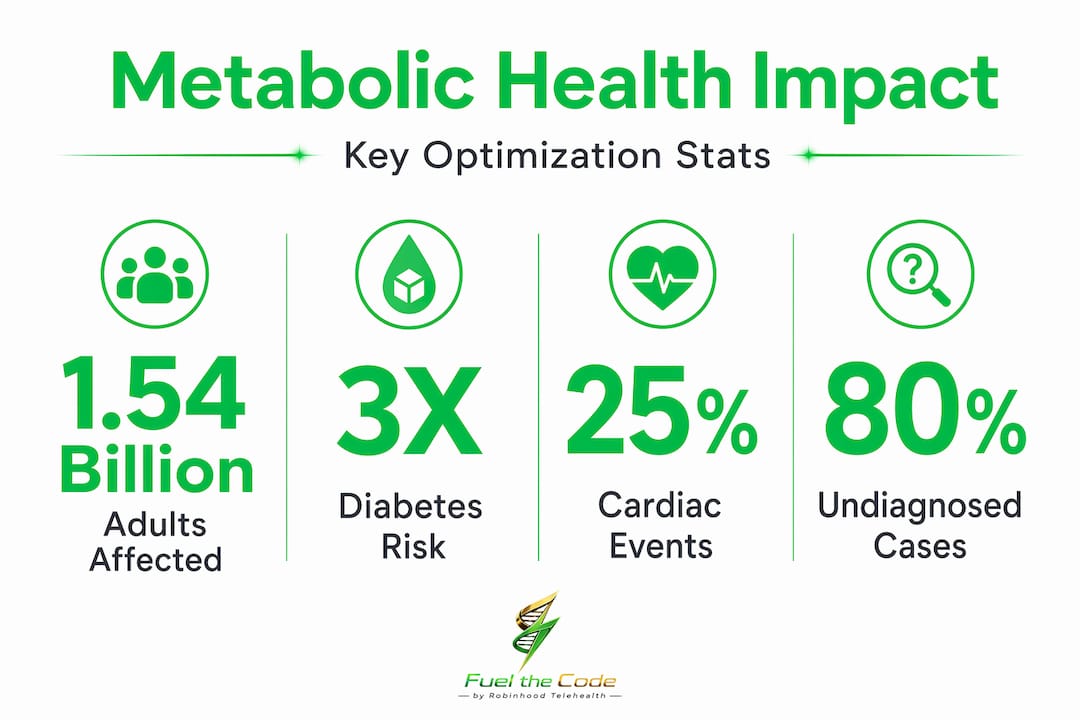
Metabolic syndrome now affects 1.54 billion adults worldwide, and most of them have no idea. If your only reason to why optimize metabolism is fitting into last year's jeans, you are leaving enormous performance, recovery, and longevity gains on the table. Metabolic function governs how your cells produce energy, regulate blood glucose, manage inflammation, and respond to hormonal signals. This guide breaks down the clinical, genetic, and lifestyle science behind metabolic optimization so you can act on it with precision, not guesswork.
Table of Contents
- Why optimize metabolism: what's really at stake for your health
- How lifestyle choices nudge your metabolism for better performance
- Beyond calories: clinical insights on targeted metabolic pathway modulation
- Applying genetic and clinical knowledge for personalized metabolism optimization
- Common pitfalls and expert tips for optimizing metabolism effectively
- A fresh perspective: why metabolism optimization is more than calorie math
- How Robinhood Telehealth supports your metabolism optimization journey
- Frequently asked questions
Key Takeaways
| Point | Details |
|---|---|
| Metabolic syndrome prevalence | Over 1.5 billion adults worldwide are affected, highlighting the urgency of metabolic optimization for health and longevity. |
| Role of insulin sensitivity | Improved insulin sensitivity through exercise and lifestyle changes supports better glucose management and recovery. |
| Beyond calorie counting | Metabolic health depends on complex pathways; targeted clinical and lifestyle interventions outperform simplistic calorie focus. |
| Personalized strategies | Genetic testing combined with phenotype tracking enables customized metabolic optimization plans. |
| Lifestyle consistency matters | Sustained habits like balanced diet, adequate sleep, stress management, and exercise are key to effective metabolism enhancement. |
Why optimize metabolism: what's really at stake for your health
Metabolism is not just a calorie furnace. It is a web of hormonal signaling, enzymatic reactions, and cellular energy management that determines how you feel at 3 p.m., how fast you recover after training, how well you sleep, and how long you live in good health.
When metabolic function degrades, the consequences go far beyond weight gain. Metabolic syndrome raises risk for type 2 diabetes, cardiovascular disease, and premature death even before any clinical symptoms appear. You can be lean, athletic, and still harboring insulin resistance quietly driving that risk upward.
This matters because metabolic dysfunction is often invisible until something breaks. The classic markers, elevated fasting glucose, high triglycerides, low HDL cholesterol, elevated blood pressure, and excess abdominal fat, tend to cluster together. Miss one, and you can still be on a trajectory toward serious cardiometabolic disease.
Understanding metabolic rate means understanding the full system, not just the number of calories burned at rest.
Core components of metabolic health include:
- Insulin sensitivity: How efficiently your cells respond to insulin and clear glucose from the blood
- Mitochondrial function: The energy output capacity of your cells, especially in muscle tissue
- Hormonal balance: Thyroid hormones, cortisol, leptin, and adiponectin all modulate metabolic rate
- Inflammatory load: Chronic low-grade inflammation directly impairs glucose metabolism
- Lipid metabolism: How your body processes dietary fats and manages triglyceride storage
"Metabolic health is not a single number. It is a dynamic state shaped by genetics, behavior, environment, and time. Optimizing it means influencing as many of those inputs as you credibly can."
Critically, insulin resistance genetics play an independent role here. Genetically predicted insulin resistance links to cardiometabolic disease and aging outcomes entirely independent of body fat percentage or muscle weakness. That means two people with identical physiques can carry very different metabolic risk profiles based on their DNA alone. This is exactly why optimizing metabolic health cannot be reduced to a body weight target.
How lifestyle choices nudge your metabolism for better performance
Once you understand metabolism's broad health role, the next question is practical: what daily levers actually move the needle?
Exercise is the most immediate and potent tool available. A single moderate-intensity session improves insulin sensitivity for 12 to 48 hours after the workout ends, but the effect is not linear. You need to hit roughly 900 kcal of energy expenditure in that session for a measurable improvement. A 20-minute jog does not get you there. A 60-minute ride at moderate effort, a long strength session, or a combination of both does.

Protein intake creates a secondary metabolic benefit most people underuse. Digesting protein costs more energy than digesting carbohydrates or fat, a phenomenon called the thermic effect of food. Increasing protein intake simultaneously raises metabolic rate, supports muscle mass preservation, and keeps you satiated longer. Aiming for 0.7 to 1 gram per pound of body weight is a reasonable starting point for active individuals.
Sleep and hydration are less glamorous but functionally critical. Sleep deprivation impairs glucose tolerance within days. Even mild dehydration reduces cellular efficiency and can blunt the hormonal signals that regulate appetite and energy balance. These are not optional add-ons; they are foundational to healthy eating and metabolism.
Chronic stress is a metabolic saboteur that most fitness-focused people dramatically underestimate. Elevated cortisol drives glucose into the bloodstream via gluconeogenesis, promotes fat storage in visceral depots, and directly suppresses thyroid hormone output. Managing stress is not soft advice. It is a metabolic intervention.
Key lifestyle levers for metabolic optimization:
- Exercise sessions targeting 900+ kcal expenditure for insulin sensitivity gains
- Protein-forward meals to capitalize on the thermic effect and preserve lean mass
- 7 to 9 hours of sleep to protect glucose tolerance and hormonal balance
- Consistent hydration throughout the day, not just around workouts
- Active stress management through breathwork, training periodization, or parasympathetic recovery practices
Pro Tip: Time your largest protein serving within two hours after your main training session. This is when your muscle cells are most insulin-sensitive, meaning nutrients get routed to muscle repair rather than fat storage.
Understanding peptide protocols and metabolic health becomes especially relevant here, because certain peptides directly modulate the hormonal axes that govern the lifestyle factors above.
Beyond calories: clinical insights on targeted metabolic pathway modulation
Diet and exercise are foundational, but they are not the whole picture. Clinical science has identified specific molecular mechanisms that open up additional pathways for metabolic improvement.
Metformin is the clearest example. For decades it was used for type 2 diabetes management, and the assumption was that it reduced hepatic glucose production. Recent research refined that picture significantly. Metformin inhibits mitochondrial complex I primarily in intestinal epithelial cells, not the liver, reducing glucose absorption from the gut and blunting the post-meal glucose spikes that drive insulin resistance over time.
Why does that distinction matter? Because it tells you that metabolic interventions need to account for where they act in the body, not just what they do biochemically. Tissue-specific timing and pharmacokinetics determine whether a clinical tool actually reaches its intended target effectively.
| Intervention | Primary mechanism | Key metabolic benefit | Timing consideration |
|---|---|---|---|
| Metformin | Intestinal complex I inhibition | Reduces post-meal glucose spikes | Take with or just before meals |
| High-intensity exercise | GLUT-4 translocation in muscle | Increases glucose uptake without insulin | Active during and 24-48 hours post-session |
| Protein-rich meals | Thermic effect of food | Elevates resting metabolic rate transiently | Distribute across meals for sustained effect |
| Peptide therapies | Hormonal axis modulation | Supports GH, insulin, and recovery signaling | Protocol-dependent, clinician-guided timing |
The clinical mechanisms of metabolic drugs reinforce a broader truth: meaningful metabolic optimization is not about eating less and moving more. It involves identifying which pathways are underperforming in your specific biology and applying targeted support to those nodes.
Pro Tip: If you are currently using metformin or evaluating it, take it with your highest-carbohydrate meal of the day. That is when post-meal glucose spikes are highest, and matching the drug's intestinal action to peak glucose exposure maximizes its benefit.
Applying genetic and clinical knowledge for personalized metabolism optimization
Generic advice produces generic results. The reason metabolism optimization techniques fail most people is not lack of effort. It is lack of personalization.
Here is how to build a strategy that is specific to your biology:
- Get your genetic risk profile. Assess for variants affecting insulin signaling, lipid metabolism, and inflammatory pathways. Genetic insulin resistance risk predicts cardiometabolic and aging outcomes independently of body composition, so knowing your genetic baseline changes your target entirely.
- Pair genetics with clinical markers. Fasting glucose, HbA1c, fasting insulin, triglycerides, HDL cholesterol, hsCRP, and blood pressure give you a real-time readout of where your metabolic system is performing below its ceiling.
- Establish a phenotype tracking rhythm. Testing once is a snapshot. Testing quarterly gives you a trend. Fitness markers like VO2 max, resting heart rate, and body composition shifts fill in the picture between blood draws.
- Design lifestyle protocols around your specific gaps. Someone with genetically driven elevated triglycerides needs a different dietary strategy than someone whose primary marker is impaired fasting glucose.
- Integrate personalized peptide protocols where clinically appropriate. Peptides that support growth hormone release, insulin-like growth factor activity, or cellular repair can target the gaps that diet and exercise alone do not close.
| Approach | Generic strategy | Personalized strategy |
|---|---|---|
| Diet | Reduce calories | Adjust macros based on insulin sensitivity genetics |
| Exercise | Do more cardio | Target 900+ kcal sessions timed to metabolic windows |
| Supplementation | Take a multivitamin | Address specific nutrient gaps shown in functional testing |
| Clinical support | No intervention until disease | Use peptides and monitoring to optimize before decline |
Pro Tip: Do not wait for a diagnosis to start personalizing your metabolic strategy. The window between "metabolically suboptimal" and "clinically diagnosable" is exactly where the most impactful interventions live.
Common pitfalls and expert tips for optimizing metabolism effectively
Most people who struggle to improve their metabolic health are not failing because of bad information. They are failing because of inconsistency, miscalibrated effort, and a misunderstanding of what progress actually looks like.
The biggest mistakes:
- Expecting fast results. Metabolic adaptation is a slow process. Stacking small lifestyle levers consistently, protein intake, sleep, exercise intensity, and stress management, produces compounding gains that a two-week "metabolism reset" never will.
- Under-dosing exercise. A 20-minute walk is good for general health. It will not produce measurable insulin sensitivity improvements. If performance and recovery are your goals, you need sessions that cross the 900 kcal threshold at least two to three times per week.
- Neglecting sleep and stress. These are not recovery tools. They are metabolic inputs. Skimping on either while dialing in your nutrition is like fine-tuning a car engine while leaving a leak in the fuel line.
- Tracking weight as the primary metric. Weight is a lagging indicator that reflects water, glycogen, muscle, and fat all at once. Waist circumference, fasting insulin, energy levels, and training performance give you far more actionable data.
Pro Tip: Build your metabolic tracking dashboard before you start any new protocol. Decide what three to five markers you will measure, how often, and what threshold triggers a protocol adjustment. You need a feedback loop, not just effort.
Consistent nutrition planning is one of the most undervalued tools in this process. Most people eat reactively. A planned approach removes hundreds of small decisions that collectively erode adherence.
A fresh perspective: why metabolism optimization is more than calorie math
Here is what fifteen years of following the metabolic health literature makes clear: calorie counting is not wrong, it is just catastrophically incomplete as a framework for anyone serious about performance, recovery, and longevity.
The calorie-in, calorie-out model works as a rough approximation for simple weight change. It breaks down entirely when you are trying to optimize insulin sensitivity, reduce cardiometabolic risk, support cellular repair, or extend your healthspan. Those outcomes are governed by which metabolic pathways are active, not just how much energy flows through the system.
Metabolism is largely genetic but remains responsive to multiple compounding lifestyle and clinical inputs. That is not a reason for fatalism. It is a reason for precision. If your genetic profile shows elevated insulin resistance risk, reducing carbohydrates alone is a blunt instrument. Combining carbohydrate timing, exercise energy expenditure targets, sleep quality, and a targeted clinical protocol is how you actually move the needle.
The athletes and health-conscious individuals who get the best long-term metabolic outcomes are not the ones who are most disciplined about calories. They are the ones who treat their metabolism as a dynamic system, monitor it with real data, adjust based on feedback, and use every available tool, lifestyle, genetic, and clinical, in concert. That is what metabolic health importance actually looks like when it is taken seriously.
How Robinhood Telehealth supports your metabolism optimization journey
Understanding why optimize metabolic health is the first step. Acting on it with the right tools is what separates intent from results.

Robinhood Telehealth's premium peptide therapy integrates genetic testing, clinical metabolic markers, and licensed practitioner oversight into protocols designed around your specific biology, not a population average. Whether your goal is improving insulin sensitivity, enhancing recovery, or building a longevity-focused metabolic baseline, the platform combines AI-driven nutrition planning, supplement stacks, and clinician-guided safe peptide protocols into a single, personalized system. If you are ready to move beyond generic advice and build a data-backed metabolic strategy, this is where that work begins.
Frequently asked questions
Why is optimizing metabolism important beyond weight loss?
Optimizing metabolism improves insulin sensitivity and reduces cardiometabolic risks that directly affect longevity and performance. Metabolic syndrome raises risk for type 2 diabetes, cardiovascular disease, and premature mortality entirely independently of body weight.
How does exercise improve metabolism and recovery?
A single moderate-intensity session improves insulin sensitivity for 12 to 48 hours, creating a metabolic window that accelerates recovery and enhances performance readiness. You need to reach roughly 900 kcal of energy expenditure per session to trigger this effect.
Can genetic testing help personalize metabolism optimization?
Yes. Genetic insulin resistance risk predicts cardiometabolic disease and aging outcomes independently of body fat, which means your DNA informs which interventions will have the highest impact for your specific biology.
Is there a quick fix to boost metabolism?
No. Stacking small lifestyle levers, consistent protein intake, quality sleep, exercise above threshold levels, and stress management, produces lasting metabolic gains. Single interventions without consistency rarely hold.