

Most people treat a grocery list like a Post-it note. You jot down milk, eggs, bread, and whatever else comes to mind while standing in the kitchen. But what is a personalized grocery list, really? It's something fundamentally different. A personalized grocery list is built from your actual meal plan, your specific dietary needs, your household size, and your health goals. It's not a generic template you found online. It's a dynamic tool that changes week to week and actually connects what you eat to how you feel.
Table of Contents
- Key takeaways
- What a personalized grocery list actually is
- How AI and technology make personalized lists smarter
- Comparing types of personalized grocery lists
- How to create your own personalized grocery list
- My honest take on personalized grocery lists
- Take your nutrition strategy further with Robinhoodtelehealth
- FAQ
Key takeaways
| Point | Details |
|---|---|
| Personalized lists start with meal plans | Your grocery list should flow directly from your weekly meals, not from guesswork or habit. |
| Dietary needs shape every item | Restrictions like gluten-free or dairy-free must be built into the list from the start, not added as afterthoughts. |
| AI tools reduce the mental load | Apps like Any.do and Microsoft Copilot learn your patterns and automate much of the list-building process. |
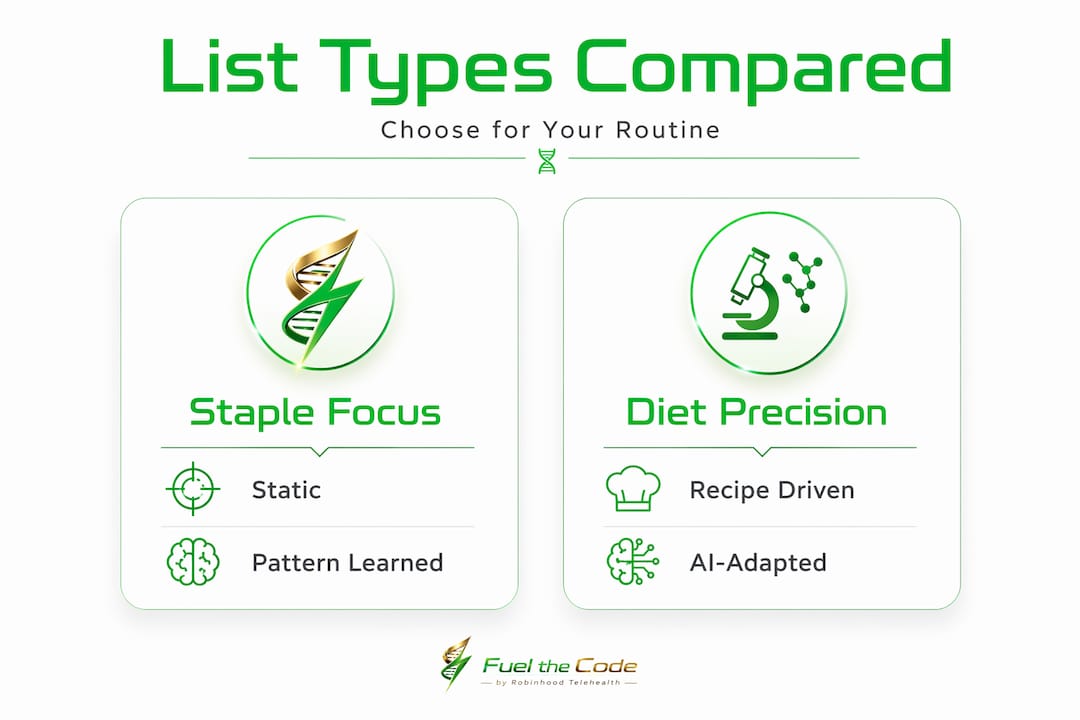
| Tool type should match your need | Pattern-learning tools work best for staple management; recipe-driven tools work best for dietary precision. |
| Regular updates keep lists effective | Reviewing your list weekly for seasonality and changing goals prevents it from going stale. |
What a personalized grocery list actually is
A personalized grocery list is generated from your specific meal plan and household needs, not pulled from a one-size-fits-all template. That distinction matters more than it sounds. When your list comes from your actual recipes, every item on it has a purpose. Nothing sits in your cart because you thought you might need it.
The core of any good personalized shopping list starts with your meals. If you're planning chicken stir-fry on Tuesday and lentil soup on Thursday, your list reflects those exact ingredients in the exact quantities you need. No more buying a full bunch of cilantro when a recipe only calls for a tablespoon. Quantity adjustments and swap options tied to individual preferences are what separate a personalized list from a scribbled note.
The building blocks of a personalized list
Here's what a well-built personalized grocery list actually incorporates:
- Meal plan integration. Every item traces back to a specific recipe or planned meal, which eliminates duplicates and gaps.
- Serving size adjustments. Cooking for two is radically different from cooking for six. Your list should scale accordingly.
- Dietary restrictions. Whether you're gluten-free, vegetarian, or managing a food allergy, those parameters get baked into every item before you print or open the app.
- Household preferences. One person hates mushrooms. Another needs a nut-free option. A good list accounts for the real humans eating the food.
- Category organization. Grouping items by store section (produce, dairy, frozen) cuts shopping time significantly.
This last point is underrated. A custom grocery list organized by store layout means you stop walking back across the store because you forgot to grab olive oil when you were in the condiment aisle.
Pro Tip: Before you build your list each week, write out every meal you plan to cook and the number of servings you need. That five-minute step prevents at least three unnecessary trips back to the store.

If you're managing nutrition for the whole family, grocery list planners can significantly improve dietary adherence by giving everyone a structure to work from.
How AI and technology make personalized lists smarter
Building a custom grocery list by hand every week is possible. It's also tedious. That's where modern tools change the equation, and they've gotten genuinely good at this.
Here are the main ways technology has improved personalized list creation:
- Recipe-to-list conversion. Microsoft Copilot converts chosen recipes or full weekly meal plans into organized lists with quantities and dietary swap suggestions automatically. You paste in your meals; it outputs your list.
- Purchase pattern learning. Apps track what you buy regularly and flag when you might be running low. Any.do's shared grocery list learns purchase patterns, tracks regular buys, and syncs in real time across devices.
- Household syncing. Real-time sharing means your partner can add oat milk from their phone while you're already at the store, without a text chain.
- Dietary swap suggestions. If a recipe calls for all-purpose flour and you're gluten-free, AI tools can surface alternatives automatically rather than forcing you to research substitutions mid-trip.
- Voice-activated reorders. Amazon Alexa for Shopping uses personal preferences and purchase history to offer tailored recommendations and reorder workflows, so you can rebuild a list with a few words while you're cooking.
"Personalized lists that learn your buying habits save time by reducing the need to repeatedly add staple items manually." — Any.do blog
The practical result is a system that gets lighter to maintain over time. You stop rebuilding from scratch every Sunday. The list remembers that you buy almond butter every two weeks, that you always need olive oil, and that someone in your household has a thing for Greek yogurt.
For people tracking specific performance goals, a meal planning approach for athletes pairs naturally with AI-driven list tools because the nutritional specificity required goes well beyond what memory alone can manage.
Comparing types of personalized grocery lists
Not every personalized list works the same way, and choosing the wrong type for your lifestyle is a common mistake. Here's how the main categories break down.
| List type | How it works | Best for | Limitation |
|---|---|---|---|
| Static template | Pre-filled categories you edit manually each week | Simple, low-tech households | No memory, no learning, requires full manual input |
| Pattern-learning list | App tracks frequent purchases and auto-suggests reorders | People who buy similar staples week to week | Weak at handling varied or diet-specific meal plans |
| Recipe-driven list | Converts meal plans into quantity-adjusted, diet-aware lists | Health-focused planners with rotating menus | Requires upfront input of recipes and dietary parameters |
| Hybrid AI list | Combines pattern learning with dietary preferences and meal data | Most users with mixed needs | Can require more setup time initially |
The pattern-learning type (best represented by apps like Any.do) shines when you have a consistent weekly routine. It tracks items you buy frequently and simplifies list rebuilding without you having to think about it. But it won't help you if you're rotating between four different dietary protocols or meal prepping for specific macros.
Recipe-driven lists, powered by tools like Microsoft Copilot, handle that complexity well. They're built for people following a grocery list for specific diets because swap suggestions and category organization come standard. The trade-off is that you need to put your meal plan in upfront.
Pro Tip: If you spend most of your mental energy on what to cook rather than what to buy, go recipe-driven. If the shopping itself feels chaotic but your meals are predictable, a pattern-learning app will solve more of your actual problem.
Selecting the right tool comes down to identifying your biggest friction point: staple management or dietary precision.
How to create your own personalized grocery list
Knowing what a personalized list is and actually building one are two different things. Here's how to move from concept to a system that works.
- Start with your weekly meal plan. Write out every breakfast, lunch, dinner, and snack before you touch the list. If you don't have a meal plan yet, a healthy meal planning checklist gives you a structured starting point.
- Pull ingredients from each recipe. Go meal by meal and list every ingredient. Don't estimate. Check the actual recipe.
- Adjust for servings. If the recipe serves four and you're cooking for two, cut the quantities in half. If your household has six people, scale up. Quantity adjustments and swaps are where most homemade lists fall apart.
- Flag dietary restrictions upfront. Before you finalize the list, run through each item and confirm it fits every person's needs. Note any substitutions you'll need at the store.
- Organize by store category. Group everything by section: produce, proteins, dairy, grains, frozen, pantry staples. Your shopping becomes linear instead of scattered.
- Add your standing staples. Olive oil, coffee, toilet paper. These items belong on every list regardless of the meal plan. If you're using a pattern-learning app, it handles this automatically.
- Share and sync with your household. Whether you use a shared notes app or a dedicated list tool, anyone who shops should have access to the live list before they leave.
- Review weekly and update for seasonality. Summer and winter eating patterns differ. So do January health goals versus November comfort food cravings. Let your list evolve.
For families managing kids' nutritional needs alongside adult dietary goals, grocery lists for kids provide a useful framework for making sure everyone's needs get covered without doubling the planning effort.
My honest take on personalized grocery lists
I've watched people spend weeks researching the best apps for grocery lists while their actual problem is much simpler: they never connected their shopping to their meals in the first place. The tool matters less than the habit.
What I've found is that most people underestimate how much mental energy a generic list wastes. You're at the store, you've grabbed everything on the list, and you get home to realize you have ingredients for three different half-meals but nothing complete. That's not a shopping problem. That's a planning problem that a personalized list solves at the source.
The insight that changed how I approach this: personalization isn't just about labeling a list as "gluten-free" or "low carb." The real value is in the specificity of quantities and the swap logic. A list that says "buy pasta" and a list that says "buy 12 oz. brown rice pasta to substitute for regular pasta in Tuesday's casserole" are solving two completely different problems.
My honest advice on AI tools versus manual planning: start manual. Build the habit of connecting your meals to your shopping first. Then automate the tedious parts once you understand what your list actually needs. Jumping straight to an AI tool before you've clarified your dietary parameters usually produces a smarter version of the same generic list you started with.
— G
Take your nutrition strategy further with Robinhoodtelehealth
A personalized grocery list is one piece of a larger nutrition strategy. If your health goals extend beyond meal planning into performance, recovery, or metabolic optimization, Robinhoodtelehealth offers the clinical tools to go deeper.
Robinhoodtelehealth's genetic fitness testing gives you DNA-based insights that directly inform what your personalized shopping list should prioritize, from macronutrient ratios to specific food sensitivities your body is genetically predisposed to. For those managing hormonal balance or metabolic health, the platform's peptide and GLP-1 protocols are clinician-guided and designed to complement precision nutrition. When your grocery list is built on the same science as your health protocol, the results are measurably different. Robinhoodtelehealth makes that connection possible.
FAQ
What is a personalized grocery list?
A personalized grocery list is a shopping list built from your specific meal plan, dietary restrictions, household size, and health goals. It differs from a generic list by linking every item to a planned meal with adjusted quantities.
How do I create a personalized grocery list?
Start by writing out your weekly meals, pull every ingredient from each recipe, adjust quantities for your serving size, flag dietary restrictions, then organize items by store category for efficient shopping.
What are the best apps for grocery lists?
Microsoft Copilot converts full meal plans into organized, diet-aware lists with quantity adjustments. Any.do learns your purchase patterns and syncs across household members in real time. Amazon Alexa for Shopping offers voice-driven reorder workflows based on your history.
Can a personalized grocery list help with specific diets?
Yes. A grocery list for specific diets incorporates ingredient swaps and category organization from the start, so items like gluten-free pasta or dairy alternatives replace standard options automatically rather than as an afterthought.
What is the difference between a static and a personalized shopping list?
A static list is a reusable template you edit manually each week with no memory of your habits or meals. A personalized shopping list adapts to your meal plan, tracks your preferences, and adjusts quantities based on who is actually eating.