

Supplements for growth are defined as dietary aids that fill nutrient gaps required for the body's normal biological development processes. They do not override genetics or act as growth hormones. Instead, they provide the raw materials, including protein, vitamins, and minerals, that the body needs to build bone, tissue, and muscle during critical development windows. When the diet falls short, these gaps directly limit how effectively the body can express its genetic growth potential. Understanding the role of supplements in growth means separating what the science actually supports from what marketing overpromises.
What role do supplements play in growth?
Supplements influence growth by correcting specific nutritional deficiencies that would otherwise restrict normal biological development. Nutrition influences up to 40% of achieved height, which means dietary adequacy is a significant lever. Supplements become most relevant when food intake is insufficient, dietary variety is limited, or rapid growth phases create demands that diet alone cannot meet.
The key nutrients involved in linear growth include protein, calcium, vitamin D, zinc, magnesium, and B-complex vitamins. Protein supplies the amino acids needed for tissue synthesis and stimulates insulin-like growth factor 1 (IGF-1), a hormone directly linked to bone and muscle growth. Calcium and vitamin D work together to build bone density, while zinc and magnesium support cell division and hormone regulation. B-complex vitamins drive the metabolic processes that convert food into usable energy for growth.

One nuance that most generic supplement labels miss is the role of Vitamin K2. Vitamin K2 in the MK-7 form directs calcium into bone tissue rather than allowing it to deposit in soft tissue. Without K2, even adequate calcium and vitamin D intake may not translate into optimal bone mineralization. This is a formulation detail that separates well-designed growth support supplements from commodity products.
Pro Tip: When evaluating any growth supplement, check the label for Vitamin K2 MK-7 alongside calcium and vitamin D. The absence of K2 is a sign the formulation was not built with bone health as the primary goal.
Which nutrients in supplements have the strongest evidence for linear growth?
The clinical evidence for specific nutrients is more concrete than most people realize. A 180-day intervention using a specialized oral nutritional supplement reduced childhood stunting by 38%, with stunting prevalence dropping from 40.7% to 25.3%. That result came from a formula delivering protein, vitamins D, C, and B-complex, along with calcium, phosphorus, magnesium, and iron. The breadth of that nutrient profile is the point: growth is not driven by a single compound but by a coordinated supply of multiple micronutrients working together.
Whey protein stands out as one of the most studied individual ingredients. A 12-week trial using high-whey protein biscuits in stunted children delivered 13.8 g of protein per day and produced a mean height increase of 1.77 cm while significantly raising IGF-1 levels. IGF-1 is the primary growth mediator in bone elongation, so this finding confirms that branched-chain amino acid (BCAA)-rich proteins do more than build muscle. They activate the hormonal signaling that drives skeletal growth.
Botanical extracts are a newer category with emerging evidence. A 24-week trial of WCO31, a blend of green onion (Allium fistulosum) and oat (Avena sativa) extracts dosed at 1.2 g daily in children aged 6 to 8, produced a 0.74 cm net height increase over placebo with no adverse safety events. Height-for-age Z-scores also improved significantly. This is not a dramatic number, but it is statistically meaningful and achieved without any known risk, which matters when evaluating supplements for pediatric use.
Key nutrients with the strongest clinical backing for growth support:
- Protein (especially whey): Drives IGF-1 production and provides amino acids for tissue synthesis
- Calcium and Vitamin D: Build bone density and support skeletal elongation
- Vitamin K2 (MK-7): Directs calcium into bone rather than soft tissue
- Zinc: Supports cell division and growth hormone receptor function
- Magnesium: Regulates hundreds of enzymatic reactions involved in tissue growth
- B-complex vitamins: Power the metabolic processes underlying all growth activity
How do different types of growth supplements compare?
Not all supplement categories deliver equal results. The evidence varies significantly by product type, population, and context.
| Supplement type | Evidence strength | Best use case | Key limitation |
|---|---|---|---|
| Oral nutrition supplements (multi-nutrient) | Strong | Stunted or nutrient-deficient children | Requires consistent daily use over months |
| Whey protein supplements | Strong | Children with low protein intake | Less effective when protein intake is already adequate |
| Botanical blends (WCO31) | Moderate | Complementary support in healthy children | Limited long-term data available |
| Lipid-based nutrient supplements | Moderate | Food-insecure, high-risk populations | Most effective when started early |
| Spirulina | Weak | General health support | No significant growth benefit confirmed |
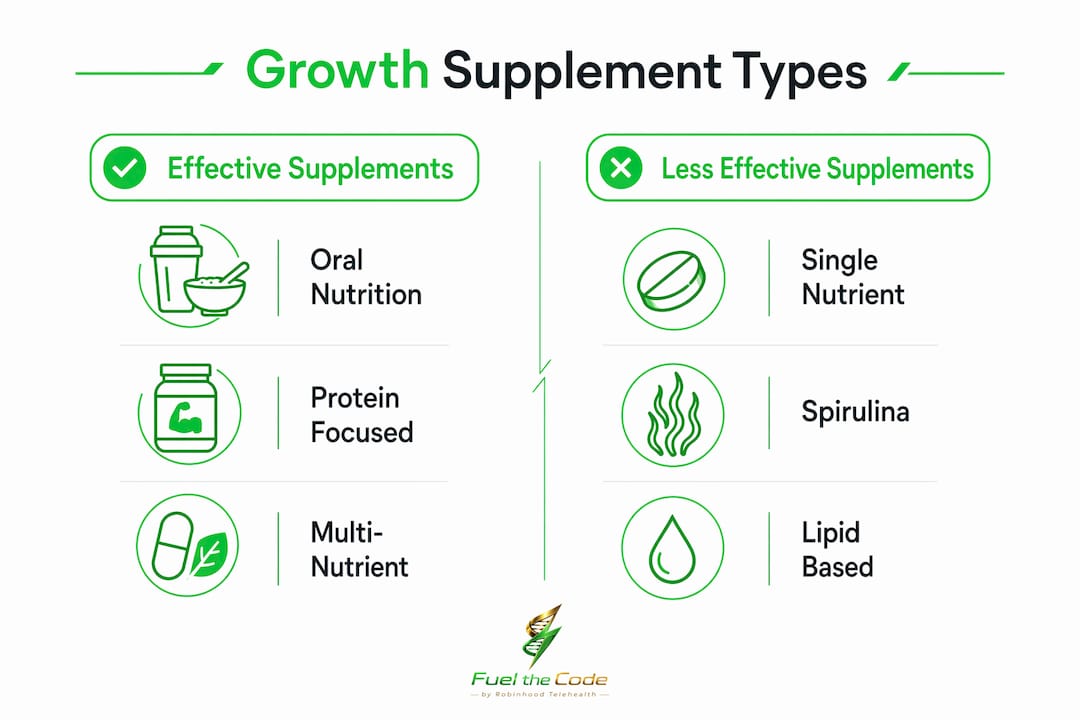
The Spirulina finding deserves direct attention. A 2026 meta-analysis found that Spirulina supplementation produced a pooled standardized mean difference for weight changes of negative 0.526 with a p-value of 0.176, meaning the result was not statistically significant. Spirulina is genuinely nutrient-dense, but nutrient density does not automatically translate into measurable growth impact. This is exactly the kind of distinction that separates evidence-based product selection from marketing-driven choices.
Lipid-based nutrient supplements show consistent but modest improvements in length-for-age Z-scores, particularly in food-insecure settings. The key variable is timing. Interventions started during the first two years of life, when growth velocity is highest, produce the most reliable outcomes. Starting supplementation later does not eliminate benefit, but the window of maximum impact narrows with age.
Pro Tip: If you are evaluating growth support supplements for a child, prioritize products with multi-nutrient profiles over single-ingredient formulas. The clinical evidence consistently favors combinations of protein, vitamins, and minerals over isolated compounds.
What are the real limitations of using supplements for growth?
Supplements do not add height beyond what genetics allow. This is the most important boundary to understand before spending money on any growth-related product. Excessive supplementation beyond what is needed to correct a deficiency does not produce additional height gains. The body uses what it needs and discards the rest, sometimes at a cost to kidney function or other systems when fat-soluble vitamins accumulate.
The practical limitations of growth supplements fall into four categories:
- Genetic ceiling: Supplements support the expression of genetic potential. They do not raise the ceiling. A child with a genetic predisposition for average height will not become tall through supplementation alone.
- Deficiency dependency: The benefits of growth support supplements are most pronounced when a real deficiency exists. Supplementing nutrients that are already adequate in the diet produces minimal additional effect.
- Sleep interaction: About 80% of natural growth hormone is released during deep sleep. Poor sleep quality directly limits growth hormone output regardless of how well-designed a supplement stack is. Magnesium and ashwagandha can improve sleep quality and indirectly support this process, but no supplement compensates for chronic sleep deprivation.
- Age and timing: Growth plates close in late adolescence. Supplementation after growth plate closure cannot produce linear height gains, though it can still support bone density, muscle mass, and overall health.
Safety profiles matter as much as efficacy. Age-appropriate dosing is not optional. Fat-soluble vitamins including A, D, E, and K accumulate in tissue and can reach toxic levels with chronic overdosing. Any supplement protocol for children should be reviewed by a pediatrician or registered dietitian before starting.
How to incorporate supplements into a growth-supporting lifestyle
Effective use of growth supplements starts with identifying whether a deficiency actually exists. A blood panel measuring vitamin D, zinc, ferritin, and IGF-1 levels gives a concrete baseline. Without that data, supplementation is guesswork. Robinhoodtelehealth's personalized meal planning approach integrates this kind of nutritional assessment into a broader performance strategy, which is the right framework for anyone serious about optimizing growth outcomes.
Once a baseline is established, the practical steps for effective supplementation are:
- Match the supplement to the deficiency. If vitamin D is low, prioritize a D3 plus K2 formula. If protein intake is inadequate, add a BCAA-rich whey protein. Do not supplement broadly without a reason.
- Prioritize transparent labeling. Look for products that list exact doses per nutrient, not proprietary blends that obscure amounts. Third-party testing certification from organizations like NSF International or USP adds another layer of quality assurance.
- Time protein intake strategically. Protein consumed within two hours after physical activity maximizes IGF-1 stimulation and muscle protein synthesis. This timing matters for adolescents in active growth phases.
- Protect sleep quality. Magnesium glycinate taken 30 to 60 minutes before bed supports deep sleep and indirectly maximizes endogenous growth hormone release. This is one of the most underused tools in a growth support stack.
- Pair supplements with a nutrient-dense diet. A healthy grocery list built around whole proteins, leafy greens, dairy or fortified alternatives, and complex carbohydrates creates the dietary foundation that supplements are designed to support, not replace.
- Consult a clinician before starting. This is not a formality. A pediatrician or sports medicine physician can identify contraindications, flag interactions with existing medications, and set realistic expectations based on individual growth trajectory data.
Key takeaways
Supplements support growth by correcting nutritional deficiencies that limit the body's ability to express its genetic potential, with the strongest evidence favoring multi-nutrient formulas, whey protein, and early intervention.
| Point | Details |
|---|---|
| Supplements fill gaps, not genetics | They support biological development within genetic limits, not beyond them. |
| Multi-nutrient formulas outperform single ingredients | Oral nutrition supplements combining protein, vitamins, and minerals show the strongest clinical results. |
| Vitamin K2 is a critical formulation detail | Without K2 MK-7, calcium may not reach bone tissue effectively, undermining the supplement's core purpose. |
| Sleep quality determines growth hormone output | About 80% of growth hormone releases during deep sleep; magnesium and ashwagandha can support this process. |
| Spirulina lacks growth-specific evidence | Meta-analysis confirms no statistically significant impact on height or weight in children and adolescents. |
What I've learned about growth supplements after years in precision health
The most common mistake I see is treating supplements as a shortcut to height. Parents purchase expensive stacks expecting measurable gains, then feel misled when the results are modest. The science is clear: supplements work when they correct something that is actually missing. When the diet is already adequate, adding more of the same nutrients produces diminishing returns.
What I find more interesting is the sleep connection. Most people focus entirely on what they put in the body and ignore the fact that growth hormone secretion is primarily a sleep-dependent process. A child taking a well-formulated multi-nutrient supplement but sleeping six hours a night is leaving most of their growth potential on the table. Magnesium glycinate is one of the most underrated tools in this space precisely because it addresses both the nutritional and sleep dimensions simultaneously.
The other thing I would push back on is the tendency to dismiss botanical extracts as unscientific. The WCO31 trial data on green onion and oat extracts is genuinely interesting. A 0.74 cm net height advantage over placebo in 24 weeks is not transformative, but it is real, reproducible, and safe. The science-backed supplement research in this area is moving faster than most practitioners realize.
My honest recommendation: get the bloodwork done first. Know your baseline. Then build a supplement protocol that targets what is actually deficient. That approach will outperform any generic growth stack every time.
— G
Optimize your growth strategy with personalized testing

Generic supplements produce generic results. Robinhoodtelehealth takes a different approach by combining DNA-based fitness testing with AI-driven meal planning and clinician-guided supplement protocols to build a strategy matched to your individual biology. If you want to know exactly which nutrients your body is missing and how to address them with precision, the platform's genetic and methylation testing gives you that data. From personalized supplement stacks to telehealth consultations with licensed practitioners, Robinhoodtelehealth connects the science of growth optimization to a plan you can actually follow. Explore the full range of wellness products and protocols to get started.
FAQ
Do supplements actually help with height growth?
Supplements support height growth only when they correct a genuine nutritional deficiency. Clinical trials show that multi-nutrient oral supplements and whey protein can produce measurable linear growth improvements in deficient children, but they do not increase height beyond genetic potential.
What is the most effective supplement for growth in children?
Multi-nutrient oral nutrition supplements combining protein, vitamin D, calcium, magnesium, and B-complex vitamins show the strongest clinical evidence. A 180-day intervention with this type of formula reduced childhood stunting by 38% in a controlled trial.
When is the best time to take growth supplements?
Protein supplements are most effective when taken within two hours after physical activity to maximize IGF-1 stimulation. Magnesium is best taken 30 to 60 minutes before sleep to support deep sleep stages, during which about 80% of natural growth hormone is released.
Is Spirulina a good supplement for growth?
No. A 2026 meta-analysis found that Spirulina supplementation produced no statistically significant impact on height or weight in children and adolescents. It has general nutritional value but lacks the specific evidence needed to qualify as a growth support supplement.
How do I know if my child needs a growth supplement?
A blood panel measuring vitamin D, zinc, ferritin, and IGF-1 levels establishes a concrete nutritional baseline. Supplementation is most justified when deficiencies are confirmed or when dietary intake is consistently inadequate due to picky eating, food insecurity, or restricted diets.