

Most people who take multiple supplements think they are doing it right. They pick a protein powder, grab some creatine, toss in a multivitamin, and call it a stack. But that is not a supplement stack. That is a shopping cart. Knowing what are supplement stacks actually means understanding the difference between random supplementation and intentional, goal-driven combinations that either work together or, when done carelessly, work against you. This guide cuts through the confusion so you can build smarter, stay safe, and get real results.
Table of Contents
- Key takeaways
- What a supplement stack actually is
- What the science actually supports
- Synergistic pairings and antagonistic combinations
- How to build your own supplement stack
- Safety limits and when to get professional guidance
- My honest take after years of watching people stack
- Build smarter stacks with Robinhoodtelehealth
- FAQ
Key takeaways
| Point | Details |
|---|---|
| Definition matters | A supplement stack is an intentional combination of 2+ supplements targeting a specific outcome, not just taking many pills. |
| Evidence is selective | Only a handful of supplements like creatine and caffeine have consistent scientific backing for performance. |
| Synergy is real | Pairings like Vitamin D3 + K2 or folate + B6 + B12 improve absorption and efficacy compared to taking each alone. |
| Safety audits are non-negotiable | Overlapping nutrients across multiple products can push you past safe upper intake levels without you realizing it. |
| Layer slowly | Introducing one supplement at a time with 2 to 4 weeks between additions helps you track what works and catch problems early. |
What a supplement stack actually is
A supplement stack is not just taking several products at once. According to evidence-based stacking principles, supplement stacks are intentional combinations of two or more supplements designed around a specific, prioritized goal, built with awareness of how those ingredients interact.
That distinction is everything. Someone taking a multivitamin, omega-3, and vitamin D to cover nutritional gaps has a foundational health stack. Someone taking creatine, beta-alanine, and caffeine before lifting has a performance stack. Someone using magnesium glycinate, ashwagandha, and L-theanine at night has a recovery and sleep stack. The goal defines the stack.
The three most common stack types in fitness and wellness include:
- Performance stacks: Pre-workout combos targeting energy, strength, and endurance. Creatine plus beta-alanine is a classic pairing for high-intensity training.
- Recovery stacks: Post-workout or evening combinations like protein, magnesium, and omega-3 designed to reduce inflammation and support tissue repair.
- Foundational health stacks: The nutrient gap coverage layer, typically a quality multivitamin, omega-3, and vitamin D, that underpins everything else.
"More supplements do not equal better results. Goal-first and overlap-aware stacking is the safest and most effective approach." — usefulvitamins.com
The difference between stacking and haphazard multi-supplement intake is intentionality. A real stack has a reason for every ingredient, a check on how those ingredients interact, and a plan for evaluating whether it is working.
What the science actually supports
Here is where most supplement content glosses over the uncomfortable truth: the research on most supplements is thin. Harvard Health notes that extra vitamins and minerals mostly do not improve athletic performance beyond what a solid, balanced diet already provides.
The exceptions worth knowing:
| Supplement | Evidence Level | Primary Benefit |
|---|---|---|
| Creatine monohydrate | Strong | Repeated high-intensity efforts, muscle mass |
| Caffeine | Strong | Endurance, power output, focus |
| Vitamin D (deficient individuals) | Moderate | Bone health, immune function, mood |
| Omega-3 fatty acids | Moderate | Inflammation reduction, cardiovascular health |
| Beta-alanine | Moderate | Muscular endurance, buffering lactic acid |
| B vitamin complexes | Context-dependent | Energy metabolism, methylation support |
Creatine and moderate caffeine consumption stand out as the most consistently supported performance supplements across decades of research. Nearly everything else sits in the "useful for specific deficiencies or contexts" category.
Regulatory context also matters here. Supplement labels carry FDA disclaimers because supplement claims are not pre-evaluated by the FDA before products hit shelves. That does not mean supplements do not work. It means you need to evaluate the actual research, not the label copy.
Pro Tip: Before adding any new supplement, ask yourself one question: what specific, measurable outcome am I targeting? If you cannot answer in one sentence, you do not need that supplement yet.
Synergistic pairings and antagonistic combinations
This is where stacking gets genuinely interesting. Some supplements genuinely amplify each other. Others block absorption or compete for the same pathways.
The most well-supported synergistic combinations include:
- Vitamin D3 + K2: D3 increases calcium absorption; K2 directs that calcium to bones rather than arteries. Taking D3 without K2 long-term, especially at higher doses, may increase calcification risk.
- Folate + B6 + B12: These three work together in the methylation cycle. Low B12 or B6 can bottleneck the entire pathway even when folate is adequate.
- Vitamin C + Vitamin E: These antioxidants recycle each other. Vitamin C regenerates oxidized vitamin E, extending its effective half-life in tissue.
For performance specifically, caffeine taken 30 to 60 minutes before exercise at 200 to 400 mg improves endurance and power output. Creatine pairs well with resistance training by supporting phosphocreatine resynthesis between high-intensity sets.
Now for the less talked-about antagonistic risks:
- Calcium + Iron: Calcium blocks iron absorption. If you take both, separate them by at least two hours.
- Zinc + Copper: High-dose zinc supplementation depletes copper over time. Watch for this in anyone using zinc for immune support.
- Multiple caffeinated products: A pre-workout, a fat burner, and an energy drink taken together can easily push total caffeine past safe daily limits without anyone counting.
Timing also shapes effectiveness. Fat-soluble vitamins (A, D, E, K) absorb better with a meal containing dietary fat. Stimulants belong in the morning or pre-workout window, not close to bedtime. Calming support supplements like magnesium glycinate and L-theanine work better at night when you are winding down toward recovery.
Pro Tip: Write out every product you take and its full ingredient list on a single sheet. Then highlight every nutrient that appears more than once. Those highlighted duplicates are where your safety audit needs to start.
How to build your own supplement stack
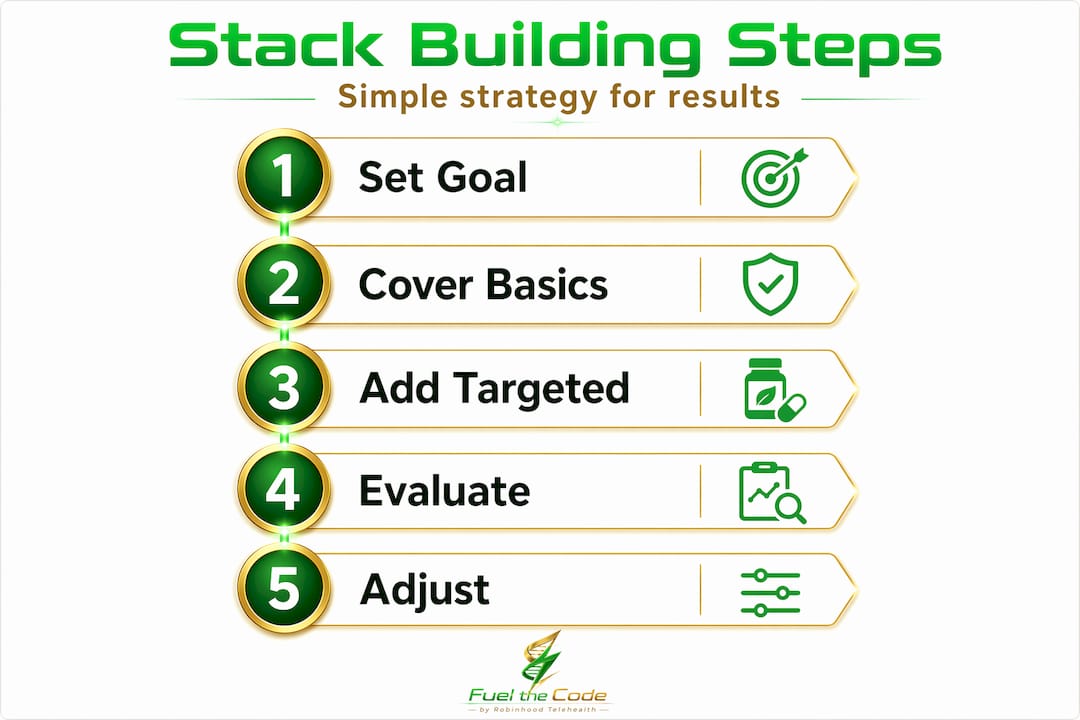
Building a supplement stack that actually serves you comes down to a specific sequence. The layering approach that works best for most people looks like this:
- Clarify your primary goal. Performance, recovery, foundational health, or metabolic support. Pick one primary focus and let that drive every subsequent decision.
- Build the foundation first. Cover common nutritional gaps before adding performance-specific supplements. A quality multivitamin, omega-3 (1,000 to 2,000 mg EPA/DHA daily), and vitamin D3 with K2 are the most common starting points for active people.
- Add one targeted supplement at a time. Introducing supplements one at a time with a 2 to 4 week observation window lets you attribute effects accurately. You cannot know what is working in a six-product stack you started all at once.
- Audit your nutrient overlap. Check every label across your full protocol. Add up total daily vitamin A, zinc, iron, caffeine, and any other nutrients appearing in multiple products. Cross-reference those totals against established safety thresholds for each nutrient.
- Track measurable markers. Sleep quality, digestion, workout performance, mood, and body composition changes are all valid data points. Keep a short weekly log rather than relying on memory.
- Cycle stimulants and performance compounds. Caffeine builds tolerance quickly. Cycling off for one to two weeks every six to eight weeks preserves its effectiveness. Some athletes also cycle creatine loading phases, though daily low-dose maintenance has its own case in the research.
Connecting your supplement choices to your overall nutrition strategy is where the real gains are found. If your diet already covers your protein, micronutrients, and caloric needs, you need far fewer supplements than you think. Check out personalized meal plans to understand how nutrition and supplementation work together before doubling down on your stack.
Pro Tip: A practical layering sequence covers common gaps first, adds one targeted layer, evaluates effects for three to four weeks, then moves to the next layer. This approach dramatically reduces side effects and saves money on supplements that were never doing anything useful.

Safety limits and when to get professional guidance
The biggest silent risk in supplement stacking is accidentally exceeding Tolerable Upper Intake Levels. ULs are not conservative recommendations. They are safety ceilings for total daily intake from all sources combined, including food. And stacking without auditing regularly lands people above them without any obvious warning signs, at least not at first.
Key areas to watch closely:
- Vitamin D: Exceeding 4,000 IU daily carries real risks and has been linked to increased fall risk in older adults. Routine high-dose supplementation without testing is not a safe default.
- Vitamin A: Fat-soluble and stored in the liver. Many multivitamins already provide significant amounts. Adding separate vitamin A supplements without checking your multi's dose is a common overlap error.
- Caffeine: Stacking stimulants is where most people undercount. Pre-workout plus thermogenic plus afternoon energy supplement can easily exceed 600 mg daily, well past what research considers reasonable.
- Iron: Iron is one of the most toxic nutrients in excess. Men and post-menopausal women almost never need supplemental iron without confirmed deficiency from bloodwork.
"Audit all nutrient sources to avoid surpassing safety ceilings for vitamins like A, zinc, iron, and caffeine when combining multiple supplement products." — ideafit.com
If you are managing chronic conditions, taking prescription medications, or over 50, a telehealth consultation before building a stack is not optional. It is smart. Bloodwork gives you the actual baseline data that makes stacking precise rather than guesswork.
My honest take after years of watching people stack
I have seen every variation of supplement overload you can imagine. Someone shows me their supplement cabinet and I count 14 products, many of them overlapping on zinc, B vitamins, and adaptogens, none of them evaluated systematically, most of them started at the same time after a single motivating article.
The honest truth is that most people do not need more supplements. They need better strategy with fewer supplements. The people I have seen get the most consistent results from stacking are not the ones with the most products. They are the ones who started simple, tracked outcomes honestly, and only added something new when there was a clear, measurable reason to do so.
The science-backed approach to supplementation consistently shows that diet and training are the primary drivers of performance. Supplements fill specific, identified gaps. That is their role. When you treat them as a shortcut rather than a support layer, you end up spending more money, introducing more risk, and often feeling worse, not better.
The one thing I consistently recommend before anything else: get your bloodwork done. Know your actual vitamin D level, your iron status, your B12. Then build a stack based on what you actually need, not what the fitness industry suggests you probably need.
— G
Build smarter stacks with Robinhoodtelehealth
Understanding the theory behind supplement stacking is one thing. Knowing exactly what your body needs based on your own biology is another level entirely.

Robinhoodtelehealth combines genetic fitness testing with DNA methylation analysis and clinician-guided protocols so your supplement strategy is built on actual data, not generalizations. Their genetic fitness panel identifies how your body responds to training, nutrition, and recovery inputs at a molecular level, giving you a foundation for smarter stacking decisions. Pair that with methylation testing to understand how your body processes B vitamins and other key nutrients, and you have a precision baseline that most people never build from. For those wanting to go further, Robinhoodtelehealth's peptide and performance protocols offer clinician-supervised recovery and longevity tools that complement a well-built supplement stack.
FAQ
What is a supplement stack in fitness?
A supplement stack is an intentional combination of two or more supplements chosen to work together toward a specific fitness or wellness goal. It differs from random multi-supplement use in that each ingredient is selected with awareness of interactions, dosing, and measurable outcomes.
What are the top supplement stacks for performance?
The most evidence-supported performance stack combines creatine monohydrate for strength and repeated efforts with caffeine taken 30 to 60 minutes before training for endurance and power output. Adding a foundational layer of omega-3 and vitamin D supports recovery and overall health.
How do you build a supplement stack safely?
Start by identifying one primary goal, then build a foundational layer covering common nutrient gaps. Add one new supplement every two to four weeks, audit all products for overlapping nutrients, and track measurable outcomes before making further changes.
Can supplement stacks be dangerous?
Yes, when built without auditing total nutrient intake across all products. Fat-soluble vitamins like A and D, minerals like zinc and iron, and stimulants like caffeine all have Tolerable Upper Intake Levels. Exceeding those levels unintentionally is the most common risk in poorly designed stacks.
How often should you change your supplement stack?
Evaluate your stack every eight to twelve weeks using measurable data like bloodwork, performance metrics, and body composition. Cycle or remove supplements that show no clear benefit, and adjust doses based on lab results rather than how you feel day to day.