

Walk into any supplement store or scroll through a fitness feed, and you'll see the phrase "science-backed" slapped on everything from magnesium gummies to exotic mushroom blends. But here's the problem: most consumers have no idea what that phrase actually requires to be true. "Science-backed" supplementation means the ingredient has credible evidence for a specific intended effect, typically from randomized trials or systematic reviews, not from a single animal study or a brand's internal data. This article breaks down what real evidence looks like, how context shapes efficacy, and why personalized, biomarker-guided approaches are changing the game.
Table of Contents
- What does "science-backed" supplementation really mean?
- Evaluating evidence: Quality matters
- Context counts: Nutritional adequacy, formulation, and personalization
- Personalized and biomarker-guided supplementation: What's emerging?
- The uncomfortable truth: Most supplement advice misses nuance
- Advance your wellness journey: Evidence-based telehealth solutions
- Frequently asked questions
Key Takeaways
| Point | Details |
|---|---|
| Science-backed means strong evidence | Effective supplements rely on credible human studies, not just marketing claims or traditional usage. |
| Personalization enhances value | Individual needs and biomarker-guided strategies make supplementation more meaningful and effective. |
| Formulation and context matter | The right product, dose, and timing depend on your health status and supplement type. |
| Generic advice can miss nuances | What works for one person or subgroup may not work for everyone—personalized, evidence-backed guidance is best. |
| Regulation is critical | Supplement claims require scientific substantiation and safety, especially as personalization increases. |
What does "science-backed" supplementation really mean?
The term "science-backed" gets stretched to cover almost anything these days. A company can cite a study done on mice, fund their own observational survey, or reference a mechanistic hypothesis and still slap that phrase on their label. That is a problem for anyone serious about optimizing their health, performance, and longevity.
Real science-backed supplementation starts with the quality of evidence. The American Medical Association makes it clear: credible evidence means higher-quality study designs, such as randomized controlled trials (RCTs) and systematic reviews, not claims based on traditional use or weak observational findings alone. An RCT randomly assigns people to receive the supplement or a placebo, which eliminates most of the confounding variables that make observational studies unreliable. When researchers combine multiple high-quality RCTs into a systematic review or meta-analysis, that is the strongest evidence available in nutrition science.
Here is what genuine science-backed claims look like in practice:
- Peer-reviewed publication in a credible journal, not a brand whitepaper
- Human studies with relevant populations (not just cell cultures or rodents)
- Clear, measurable endpoints like inflammatory markers, strength output, or lipid panels
- Transparent dosing that matches what is actually in the product you can buy
- Replication across independent research groups, not just one lab
"Science-backed supplementation generally means the supplement ingredient(s) have credible evidence for a specific intended effect, typically from higher-quality study designs, rather than claims based only on traditional use or weak observational findings." — American Medical Association
This distinction matters enormously for anyone trying to build a meaningful supplement stack. At Robinhood Telehealth, we apply this same filter when structuring peptide protocols or recommending specific nutrients through AI meal planning. The goal is never to sell you a trend. It is to support what your biology actually responds to. Building out a solid nutritional foundation using tools like grocery list planners can also reduce over-reliance on supplements by filling dietary gaps first.
Evaluating evidence: Quality matters
Not all studies are created equal. Knowing how to evaluate evidence is one of the most practical skills you can develop as a health-conscious individual. The AMA notes that randomization helps protect against being "fooled" by a study, and many popular supplement effects are supported mainly by animal studies rather than robust human RCTs. That gap between animal data and human outcomes is enormous and often ignored in marketing copy.

Here is how different types of evidence stack up:
| Evidence type | Strength | Pros | Cons |
|---|---|---|---|
| Animal studies | Low | Useful for mechanism discovery | Often does not translate to humans |
| Observational studies | Low to moderate | Large populations, real-world data | Cannot prove causation |
| Randomized controlled trials | High | Controls for confounding, shows causation | Expensive, short duration |
| Systematic reviews/meta-analyses | Highest | Aggregates multiple RCTs | Quality depends on included studies |
When you are evaluating a supplement's evidence base, follow these steps:
- Identify the study design. Did the research use an RCT, or was it observational? Was it conducted in humans or animals?
- Check endpoint relevance. Does the study measure something that matters to you, like strength, body composition, inflammation, or cognition?
- Assess sample size. A study with 20 participants is very different from one with 2,000.
- Confirm peer review. Was the study published in a credible, indexed journal?
- Look for independent replication. Has the finding been confirmed by researchers with no financial interest in the outcome?
A critical area people overlook is whether peptide protocols or supplements use the same dose, delivery format, and compound studied in the research. A supplement that uses a different salt form, lower dose, or poor bioavailability profile is not the same product that was studied, even if the label says it is.
Pro Tip: Always check whether the dosage on the product label matches what was used in the cited human study. A supplement using 150 mg of an ingredient when the effective dose in research was 600 mg is not giving you the studied benefit, regardless of what the packaging claims.
Context counts: Nutritional adequacy, formulation, and personalization
Here is where supplement science gets genuinely interesting and where blanket recommendations start to fall apart. The same supplement can produce meaningful results in one person and zero results in another. That is not a placebo effect. It is biology.
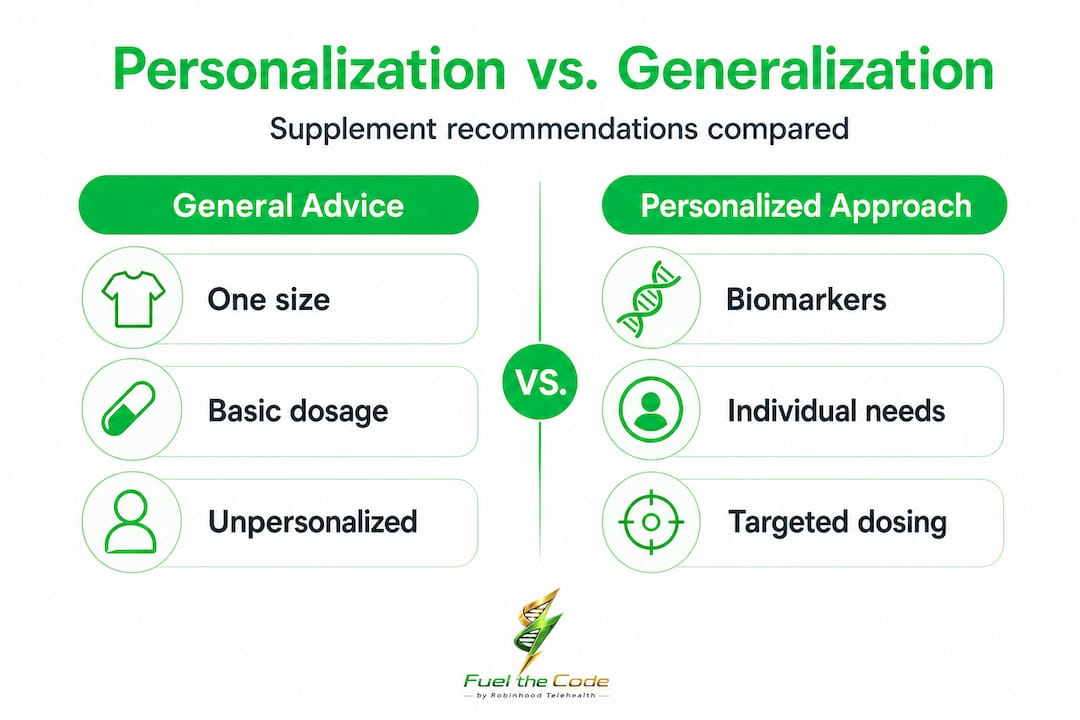
Evidence-backed supplementation often hinges on correcting a nutritional deficiency or meeting a need that diet is not fulfilling. When someone is deficient in vitamin D, supplementing produces measurable improvements in immune markers, bone density, and mood. When someone already has optimal vitamin D levels, the same dose may produce no meaningful change. The supplement did not stop working. The context changed.
| Supplementation type | Likely real-world effect | Best evidence for |
|---|---|---|
| Targeted (deficiency correction) | High impact, measurable outcomes | Vitamin D, iron, B12, magnesium |
| Broad preventive (population-wide) | Modest to minimal in replete individuals | Multivitamins, antioxidants |
| Performance-specific | Conditional on training status and diet | Creatine, beta-alanine, omega-3s |
| Biomarker-guided | Emerging, promising early data | Personalized stacks based on labs |
Formulation is the other critical variable that most advice ignores. Omega-3 supplements can vary widely in the types and amounts of EPA and DHA they contain, so evidence-based use requires checking labels rather than assuming equivalence across brands or delivery forms. An omega-3 product with 1,000 mg of fish oil might contain only 300 mg of combined EPA and DHA. Another at the same price point delivers 800 mg. These are not equivalent products.
Key formulation factors that change efficacy:
- Bioavailability: Magnesium glycinate absorbs differently than magnesium oxide
- Ratio of active compounds: EPA versus DHA matters differently for cardiovascular versus cognitive outcomes
- Delivery format: Liposomal formulations may improve absorption for fat-soluble nutrients
- Cofactors: Vitamin K2 works synergistically with vitamin D3 for calcium metabolism
Understanding safe peptide use follows the same logic. The compound, dose, injection timing, and individual metabolic context all interact to determine whether a protocol delivers real results. For those exploring AI nutrition planning alongside supplementation, layering dietary adequacy with targeted support creates a far stronger foundation than either approach alone. For a broader view of how targeted supplements compare across different health goals, fertility supplement comparisons offer a useful example of how context-driven evidence works in practice.
Pro Tip: Before spending money on a new supplement, pull your most recent bloodwork. If you do not have a deficiency or specific clinical indication, the evidence for broad preventive benefit is often weak. Spend your budget where the data and your labs actually intersect.
Personalized and biomarker-guided supplementation: What's emerging?
The frontier of supplement science is moving fast, and it is moving toward individualization. The concept is straightforward: instead of giving every 40-year-old male the same omega-3 dose, you measure their inflammatory biomarkers, lipid ratios, and genetic variants first, then tailor the intervention. The results are more predictable and the rationale is far stronger.
Biomarker-guided supplementation is an emerging methodology where intake is selected using individual measurements such as inflammatory markers, hormonal panels, and metabolic indicators. Early studies show promise, with some participants achieving meaningful reductions in C-reactive protein (CRP) and other inflammatory markers when supplementation is matched to their specific biomarker profile. However, the field is still maturing. Large, well-controlled RCTs are still needed to confirm who benefits most and by how much.
Key ways biomarker testing currently guides smart supplementation decisions:
- Inflammatory markers (CRP, IL-6): Guide omega-3 and curcumin dosing strategies
- 25-OH vitamin D levels: Determine whether supplementation is needed and at what dose
- Homocysteine and methylation markers: Direct methylated B-vitamin supplementation
- Ferritin and hemoglobin: Indicate iron supplementation need before symptoms appear
- Testosterone and cortisol ratios: Inform adaptogen and hormone-support protocol decisions
Personalized nutrition research confirms that individualized approaches can improve diet quality and some metabolic markers, but results vary significantly and long-term, well-designed trials are still required to clarify who benefits most. This does not mean personalization is not valuable. It means the science is honest about where certainty ends.
There are also regulatory considerations worth understanding. Regulatory frameworks around personalized nutrition highlight the need for safety and accuracy in diagnostic testing, credentialed practitioners guiding recommendations, substantiated scientific claims, and robust privacy protections for your health data. As biomarker-based personalization grows, so does the responsibility to work with qualified clinicians rather than relying on direct-to-consumer algorithms with no clinical oversight.
At Robinhood Telehealth, premium peptide therapy and personalized supplementation protocols are built around exactly this framework: labs first, context second, intervention third. That sequence matters.
The uncomfortable truth: Most supplement advice misses nuance
Here is what most supplement content does not tell you. The research is often stratified. Strong evidence for an ingredient in one subgroup does not mean that same ingredient works across the board. Omega-3 fatty acids are a prime example: compelling evidence exists for cardiovascular risk reduction in people with elevated triglycerides or established heart disease, but the same data does not automatically justify universal supplementation for low-risk individuals. "It works" is almost always conditional, not universal.
The second problem is that popular wellness content routinely overgeneralizes from early mechanistic findings. A cell culture study shows a compound activates a longevity pathway. A mouse study shows it extends lifespan 20%. Headlines run. Products launch. Millions of people start taking a supplement before a single well-controlled human trial has been completed. As nutrition science researchers note, without randomized evidence and appropriate endpoints, the perceived benefits from early mechanistic or observational data can be genuinely misleading.
This is not a reason to be cynical about supplementation. Creatine monohydrate is one of the most robustly studied ergogenic aids in the world, with decades of human RCT data. Vitamin D deficiency correction has clear clinical benefit. Methylated B-vitamins make a meaningful difference for people with MTHFR variants. The science exists. The problem is noise drowning out signal.
The solution is a personalized, evidence-first approach backed by peptide safety principles and clinical oversight. Generic supplement stacks built on marketing trends are a poor substitute for a protocol designed around your actual biology. Prioritize consultation over convenience, and let your biomarkers tell you what your body actually needs.
Pro Tip: If a supplement recommendation comes without a discussion of dosing, your specific health context, and the study population it was tested in, treat it as incomplete advice regardless of who is delivering it.
Advance your wellness journey: Evidence-based telehealth solutions
Understanding the evidence hierarchy is one thing. Applying it to your own biology requires tools, testing, and clinical guidance that most people cannot piece together on their own.

Robinhood Telehealth exists precisely to close that gap. Our platform combines DNA and methylation testing with AI-driven nutrition planning, clinician-guided premium peptide therapy, and personalized supplement protocols that start with your labs, not a generic formula. Whether your goals are metabolic optimization, hormone balance, recovery enhancement, or cellular protection, our licensed practitioners build protocols grounded in current evidence, not trends. You deserve a strategy built around your specific biomarkers, not the average person in a study from five years ago. Explore how precision wellness can work for you.
Frequently asked questions
How can I tell if a supplement is truly science-backed?
Look for evidence from human randomized controlled trials with clear health endpoints and transparent dosing. Science-backed claims require higher-quality study designs, not just marketing language or single observational findings.
Are personalized supplements proven to work better than standard recommendations?
Personalized approaches show promise for improving diet quality and metabolic markers, but consistent long-term benefits are still being confirmed. Personalized nutrition research finds results vary, and more well-designed trials are needed to clarify who benefits most.
Why does the formulation of a supplement matter?
Active ingredient amounts and forms differ significantly across products, making label scrutiny essential. Omega-3 supplements vary widely in EPA and DHA content, so assuming two products are equivalent because they share a name is a mistake.
What are the risks of following generic supplementation advice?
Generic advice often ignores individual context, leading to unnecessary or ineffective supplementation. Evidence for specific subgroups shows that whether a supplement "works" is often conditional on your specific health status, not universal.
Is supplement regulation different from prescription medications?
Yes, supplements face less rigorous pre-market approval than prescription drugs. Regulatory frameworks for personalized nutrition emphasize the need for credentialed experts, substantiated claims, accurate testing, and strong privacy protections as personalized approaches expand.