

Peptide therapy is no longer on the fringe of clinical medicine. With over 100 FDA-approved peptide drugs on the market and compounded peptides expanding into hormone optimization, tissue repair, and cognitive support, the field has moved decisively into mainstream functional and regenerative medicine. Yet the role of practitioners in peptide therapy remains one of the most misunderstood areas in clinical practice. Many providers assume peptides are low-risk tools that require minimal oversight. That assumption carries real liability. This guide breaks down exactly what practitioners need to know to implement peptide therapy safely, legally, and with genuine clinical rigor.
Table of Contents
- Key takeaways
- The role of practitioners in peptide therapy
- Clinical responsibilities in patient evaluation
- Safe sourcing, prescribing, and legal compliance
- Integrating peptide therapy into clinical practice
- My perspective on practitioner responsibility in this field
- Build your peptide practice on a compliant foundation
- FAQ
Key takeaways
| Point | Details |
|---|---|
| Credentials matter from the start | Board-certified MDs, DOs, NPs, and PAs with specialty training are best positioned to prescribe peptide therapy responsibly. |
| Lab monitoring is non-negotiable | Baseline and follow-up labs like IGF-1 and metabolic panels are required for safe patient management, not optional. |
| Legal exposure is real | Informed consent documentation and sourcing from licensed compounding pharmacies are the two fastest ways to reduce malpractice risk. |
| Telehealth expands access | Remote consultations and lab ordering have made it practical to offer compliant peptide protocols beyond a physical clinic. |
| Education never stops | The regulatory environment for peptides is shifting quickly, and practitioners who stop learning put both patients and their licenses at risk. |
The role of practitioners in peptide therapy
The foundation of any safe peptide program is practitioner competence, and that starts with credentials. Qualified peptide providers include board-certified physicians (MD/DO), naturopathic doctors, and advanced practice providers such as nurse practitioners and physician assistants who hold specialized training in peptide or functional medicine. A general medical license without peptide-specific education is not a sufficient qualification on its own.
The certifications that carry the most clinical weight in this field come from three organizations:
- American Academy of Anti-Aging Medicine (A4M): Offers the most recognized fellowship and certification in peptide and regenerative medicine.
- Institute for Functional Medicine (IFM): Provides training on root-cause medicine that integrates well with peptide protocols.
- International Peptide Society: One of the few organizations focused exclusively on peptide education for clinical practitioners.
Each of these pathways requires both didactic training and case-based application. They are not weekend seminars. Practitioners who skip formal certification and rely on online forums or supplement company webinars are operating with a dangerous knowledge gap.
The regulatory environment adds another layer of complexity. The FDA has been actively updating its classification of certain compounded peptides, and the field evolves with new scientific findings and enforcement actions regularly. Practitioners who treat peptide therapy as a static specialty will eventually prescribe something that has changed regulatory status without realizing it.
Pro Tip: Before enrolling patients in any peptide protocol, confirm that your specific peptide compounds remain legal for compounding under current FDA guidance. The list changes, and your malpractice insurer will not cover prescriptions that fall outside lawful compounding classifications.
Clinical responsibilities in patient evaluation
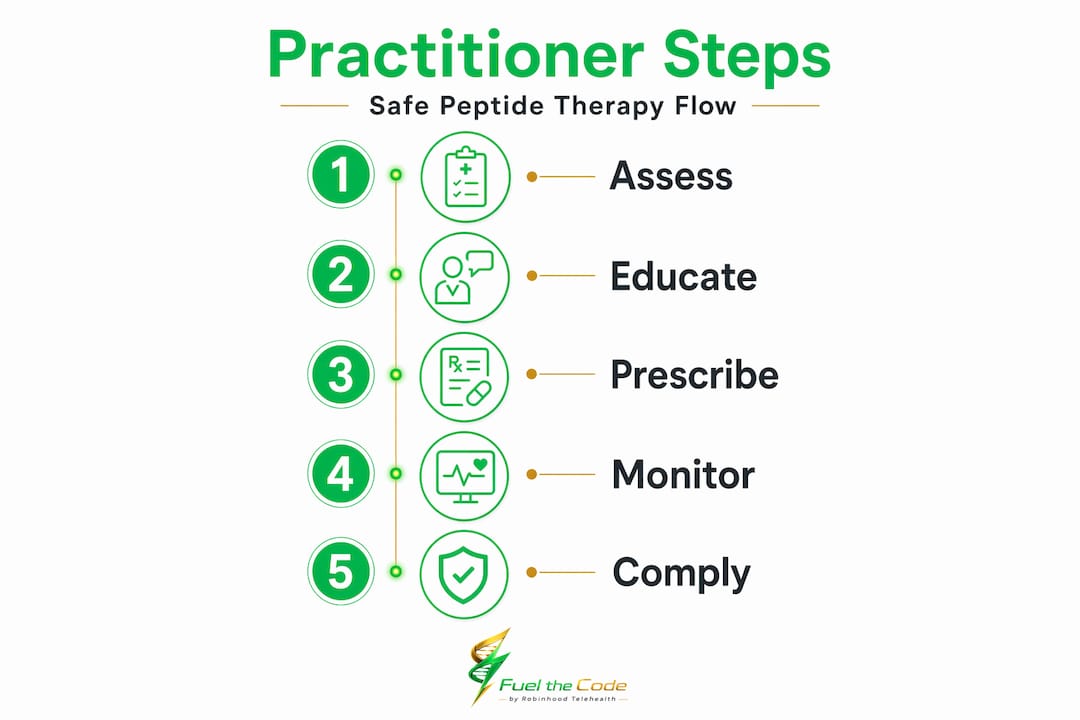
Getting peptide therapy right begins long before writing a prescription. The evaluation process is where responsible peptide therapy practitioners separate themselves from practitioners who treat these compounds as supplements with extra steps.
A thorough clinical assessment must include:
- Comprehensive medical history. Autoimmune conditions, active malignancies, and insulin resistance all represent contraindications or cautions for specific peptide classes. A history of growth-hormone-sensitive cancers, for example, rules out GH secretagogues like Ipamorelin or CJC-1295.
- Baseline laboratory workup. Ordering labs like IGF-1 and metabolic panels before prescribing is not a formality. Providers who skip this step are considered high-risk to patients. Add thyroid function, fasting insulin, and complete blood count based on the intended protocol.
- Goal alignment with clinical indication. Patient goals (body composition, recovery, cognitive function) must map to actual clinical indicators. A patient requesting BPC-157 for general "wellness" needs a clearer clinical justification than one with documented tissue injury.
- Informed consent documentation. Practitioners must explain FDA approval status, off-label use, known risks, and available alternatives before any prescription is written. Proper consent documentation is one of the strongest legal protections a practitioner has.
- Stacking and cycling assessment. Using multiple peptides without proper knowledge of their interactions can cause adverse effects or undermine the efficacy of each compound. The best practice is introducing peptides individually and establishing tolerability before combining them.
Follow-up labs should be scheduled at clinically appropriate intervals. IGF-1 rechecked at 8 to 12 weeks when using GH secretagogues is a baseline standard. Any deviation from expected biomarker response warrants a protocol adjustment before continuation.
Pro Tip: Create a standardized intake form that flags absolute and relative contraindications for the most common peptide classes you prescribe. This reduces clinical error during busy consultation blocks and creates a documented decision trail.

Safe sourcing, prescribing, and legal compliance
Regulatory compliance is where many otherwise well-trained peptide therapy experts get into serious trouble. The rules governing peptide compounding are specific, and ignorance is not a legal defense.
Legitimate peptide therapies must come from licensed 503A or 503B compounding pharmacies. The distinction matters. A 503A pharmacy compounds patient-specific prescriptions. A 503B outsourcing facility compounds in bulk under more stringent FDA oversight. Using a peptide source that does not hold one of these designations exposes both the practitioner and the patient to significant risk.
Here is what compliant sourcing and prescribing looks like in practice:
| Practice area | Compliant standard | Risk if ignored |
|---|---|---|
| Pharmacy sourcing | Licensed 503A or 503B only | Increased patient harm and practitioner liability |
| Documentation | Full prescription and clinical notes | Malpractice and licensing board scrutiny |
| Informed consent | Written, signed, and specific | Legal exposure on adverse events |
| Monitoring schedule | Defined intervals with lab criteria | Failure to detect adverse reactions early |
| Regulatory tracking | Active review of FDA updates | Prescribing a reclassified compound unknowingly |
Malpractice exposure in peptide therapy most commonly arises from three failures: inadequate patient monitoring, lack of documented clinical justification, and use of non-compliant compounding sources. Standard of care in this field is still forming, which cuts both ways. Practitioners have some flexibility, but they also bear the burden of demonstrating that their decisions were defensible at the time they were made.
The safest professional position in peptide therapy is documented thoroughness. Every clinical decision should be traceable to a lab value, a patient goal, a consent form, or a published protocol.
Record-keeping should treat each peptide prescription like any other controlled or specialized medication. That means dated clinical notes, documented rationale, lab results in the patient file, and written evidence of the consent conversation.
Integrating peptide therapy into clinical practice
Designing a functional peptide program in a clinical setting requires more than clinical knowledge. It requires workflow architecture. Practitioners in peptide treatment who try to bolt peptide protocols onto a standard appointment structure often find the process unsustainable within weeks.
A well-designed workflow covers these components:
- Dedicated consultation slots. Peptide evaluations take longer than a standard office visit. Budget at least 45 to 60 minutes for new patient intake, particularly when reviewing labs and explaining off-label use.
- Pharmacy relationships. Establish relationships with two or three compliant compounding pharmacies before you see your first patient. Turnaround times, quality documentation, and patient support vary significantly between pharmacies.
- Patient education materials. Patients need written guidance on self-injection technique, storage conditions, and what side effects warrant a call to the clinic. Verbal instruction is not enough, and it is not legally sufficient.
- Telehealth integration. Telehealth has expanded access to peptide therapy significantly. Remote consultations and lab ordering allow practitioners to serve patients who cannot travel to a clinic while maintaining compliance with prescribing laws.
- Practitioner communities. Sharing protocols and pharmacy recommendations through practitioner networks is one of the fastest ways to improve clinical quality. The field moves quickly, and peer learning accelerates your ability to respond to new evidence and regulatory changes.
Common starter protocols that practitioners frequently build around include Ipamorelin with CJC-1295 for growth hormone support, BPC-157 for tissue repair and gut integrity, and Thymosin Alpha-1 for immune modulation. Each requires its own monitoring schedule and patient education framework. For an evidence-based look at peptide protocols in practice, Robinhoodtelehealth's clinical blog provides a useful starting reference.
Understanding the complete picture of how peptide therapy works across different patient populations also helps practitioners calibrate expectations during patient education conversations.
My perspective on practitioner responsibility in this field
I have watched peptide therapy go from a niche conversation at anti-aging conferences to a mainstream clinical offering in functional medicine practices across the country. That growth has brought genuine opportunity. It has also brought a wave of providers who entered the space without adequate training, convinced that peptides were close enough to nutraceuticals that the same casual prescribing standards applied.
They were wrong, and patients paid the price for it.
What I have learned from watching both high-performing and problematic peptide programs is this: the practitioners who get consistently good outcomes are the ones who slow down at intake. They run the labs. They document the rationale. They have an honest conversation about off-label status before a single vial ships from the pharmacy. They are not faster or more creative than other practitioners. They are simply more thorough.
The regulatory environment is also creating pressure that practitioners cannot ignore. The FDA has reclassified several peptides in recent years, and that pattern is not slowing down. Practitioners who rely on what was true two years ago are operating on outdated information. The practitioners who thrive in this space treat their own education as an ongoing clinical obligation, not a one-time credential check.
My honest take is that the bar for responsible peptide prescribing is higher than most practitioners currently apply. That is not comfortable to say, but it reflects the reality of where the science and the legal standards actually are.
— G
Build your peptide practice on a compliant foundation

Robinhoodtelehealth was built specifically for practitioners and patients who want precision medicine backed by clinical science, not guesswork. If you are looking to formalize or expand your peptide therapy program, the platform offers clinician-guided peptide and GLP-1 protocols designed to meet current regulatory standards while optimizing patient outcomes. Complement your prescribing with DNA-based genetic fitness testing and methylation panels from at-home methylation testing to create truly personalized protocols grounded in each patient's biology. These tools do not replace clinical judgment. They sharpen it.
FAQ
What credentials should a peptide therapy practitioner have?
Peptide therapy practitioners should hold a board certification as an MD, DO, NP, or PA and supplement that with specialty training from organizations like A4M, IFM, or the International Peptide Society. A general medical license without peptide-specific education is not a sufficient qualification for responsible prescribing.
Why is lab monitoring required in peptide therapy?
Providers who prescribe peptides without ordering baseline and follow-up labs such as IGF-1 and metabolic panels are considered high-risk to patients. Lab results guide peptide selection, dose adjustments, and early detection of adverse responses.
What is the legal risk of prescribing peptides without informed consent?
Proper documentation of patient understanding minimizes legal risk. Without signed informed consent that covers FDA approval status, off-label use, and known risks, practitioners face significant malpractice exposure if adverse events occur.
Which compounding pharmacy type should practitioners use?
Practitioners must source peptides exclusively from licensed 503A or 503B compounding pharmacies. Using unlicensed sources increases both patient safety risk and practitioner liability in a regulatory environment that continues to tighten.
How does telehealth fit into a compliant peptide therapy program?
Telehealth consultations and remote lab ordering have expanded patient access to peptide therapy while allowing practitioners to maintain documentation and prescribing compliance. Practitioners must still verify that their state-specific telehealth prescribing laws permit the peptide compounds they intend to use.