

Peptides are everywhere in athletic circles right now. Coaches whisper about BPC-157, weekend warriors stack TB-500 after every tough session, and social media is flooded with transformation stories tied to injectable recovery compounds. But here's the reality check: BPC-157 and TB-500 lack high-quality human clinical trials for musculoskeletal recovery, with most evidence limited to small, uncontrolled studies or animal data riddled with methodological problems. Before you spend serious money or take on serious risk, you need to understand what peptides actually do, where the science holds up, and where the hype outruns the evidence.
Table of Contents
- What are peptides and how do they impact recovery?
- Popular peptides for recovery: Evidence, benefits, and limitations
- Safety, legality, and practical risks: What every athlete must know
- Integrating peptides with evidence-based recovery strategies
- What most athletes get wrong about peptides for recovery
- Explore safe, science-backed peptide options with professional support
- Frequently asked questions
Key Takeaways
| Point | Details |
|---|---|
| Evidence varies | Most peptide therapies lack human trials, but collagen peptides show solid support for muscle recovery. |
| Prioritize safety | Many peptides are banned, unregulated sources are risky, and expert supervision is key. |
| Not a shortcut | Peptides work best as complements, not substitutes, for proven recovery methods. |
| Professional guidance matters | Consult with clinicians before trying peptide protocols for athletic recovery. |
What are peptides and how do they impact recovery?
Peptides are short chains of amino acids, anywhere from 2 to 50 amino acids long, that act as signaling molecules throughout the body. Think of them as precise text messages your cells send to trigger specific biological processes. Unlike full proteins, their small size allows them to interact directly with receptors that regulate inflammation, growth, and repair at the cellular level.
The excitement around bioactive signaling peptides in athletic recovery comes from their theoretical mechanisms. Several key pathways are involved:
- Tissue repair signaling: Some peptides activate growth factor pathways, telling fibroblasts and satellite cells to multiply and rebuild damaged connective tissue and muscle fibers.
- Inflammation modulation: Certain peptides appear to shift the body away from chronic, destructive inflammation toward the controlled, short-term inflammatory response that promotes healing.
- Angiogenesis: New blood vessel formation is critical for delivering oxygen and nutrients to injured tissue, and several peptides have shown this effect in lab settings.
- Muscle protein synthesis support: Growth hormone secretagogues stimulate the pituitary to release GH, which then drives IGF-1 production, a key driver of muscle repair and growth.
- Collagen production: Specific collagen peptides directly stimulate collagen type I and type III synthesis in tendons, ligaments, and skin.
The most talked-about compounds in the athletic recovery space include BPC-157, TB-500, CJC-1295 combined with Ipamorelin, and collagen peptides. Each works through a different mechanism, and critically, each has a very different evidence profile.
Pro Tip: Not all peptides are created equal. Some have decent human data, others are purely experimental. The compound matters, and the evidence quality matters even more.
BPC-157 shows impressive tissue repair effects across more than 100 preclinical studies involving muscle, tendon, and ligament injuries in rodent models, with measurable improvements in healing speed and mechanical strength of repaired tissue. That is genuinely exciting science. It just hasn't been replicated in well-controlled human trials yet, and that gap is important.

Popular peptides for recovery: Evidence, benefits, and limitations
Not all peptides belong in the same conversation. Their mechanisms differ, their evidence bases differ, and their risk profiles differ significantly. Here is how the major players stack up.
| Peptide | Primary mechanism | Human trial quality | Key benefit | Major limitation |
|---|---|---|---|---|
| BPC-157 | Growth factor activation, anti-inflammatory | Very low (preclinical only) | Tendon and muscle repair | No controlled human RCTs |
| TB-500 | Cell migration, angiogenesis | Very low (preclinical only) | Wound healing, anti-fibrotic | No human orthopedic trials |
| CJC-1295 + Ipamorelin | GH and IGF-1 stimulation | Low to moderate | Muscle protein synthesis | No direct recovery RCTs |
| Collagen peptides | Collagen synthesis stimulation | Moderate to strong | Muscle strength, body composition | Effects modest; timing dependent |
| Plant peptides (PBPs) | AMPK activation, ROS scavenging | Very low (animal models) | Anti-fatigue, anti-inflammatory | Human data essentially absent |
Breaking each one down:
-
BPC-157: Derived from a protective protein found in gastric juice, BPC-157 has generated real scientific interest because of its ability to accelerate healing across multiple tissue types in animal models. The problem is that TB-500 and BPC-157 remain without controlled human trials for orthopedic or sports medicine applications. Translating rodent healing rates to human biology is not straightforward, and the doses used in animal studies don't map cleanly to human protocols.
-
TB-500: This is a synthetic fragment of Thymosin Beta-4, a protein naturally present in human cells. It promotes cell migration, stimulates angiogenesis, and demonstrates anti-fibrotic effects in preclinical models, meaning it may reduce scar tissue formation after injury. These are valuable properties on paper. But again, no controlled human trials for orthopedic recovery exist.
-
CJC-1295 with Ipamorelin: This combination works by stimulating the pituitary gland to release growth hormone in a more natural, pulsatile pattern. GH secretagogues increase GH and IGF-1 levels in human studies, which indirectly supports muscle protein synthesis and recovery signaling. The caveat is that no randomized controlled trials have specifically tested these peptides as recovery agents in competitive athletes.
-
Collagen peptides: This is where the evidence actually gets solid. Collagen peptide supplementation paired with resistance training improves muscle strength, fat-free mass, and body composition in randomized controlled trials with both older adults and athletes. The effects are modest but real and reproducible. Timing matters too: consuming collagen peptides with vitamin C about 30 to 60 minutes before exercise appears to maximize collagen synthesis in connective tissue.
-
Plant-derived bioactive peptides (PBPs): Sourced from foods like soy, rice, peas, and hemp, plant peptides alleviate exercise fatigue through reactive oxygen species scavenging, anti-inflammatory mechanisms, and AMPK pathway activation in animal studies. Human trials are essentially nonexistent at this point.
Pro Tip: If you want a peptide with actual human evidence right now, start with collagen peptides. They are legal, widely available, well-studied, and carry minimal risk. The more advanced compounds require clinical oversight and carry real uncertainty.
The science and risks of peptides across these compound classes are nuanced. Understanding the difference between "interesting in animal models" and "proven in humans" is the single most important distinction you can make before deciding on a protocol.
Safety, legality, and practical risks: What every athlete must know
The conversation around peptides cannot stay purely scientific. There are hard practical realities that affect every athlete considering these compounds, and ignoring them puts your career, your health, and your money at serious risk.
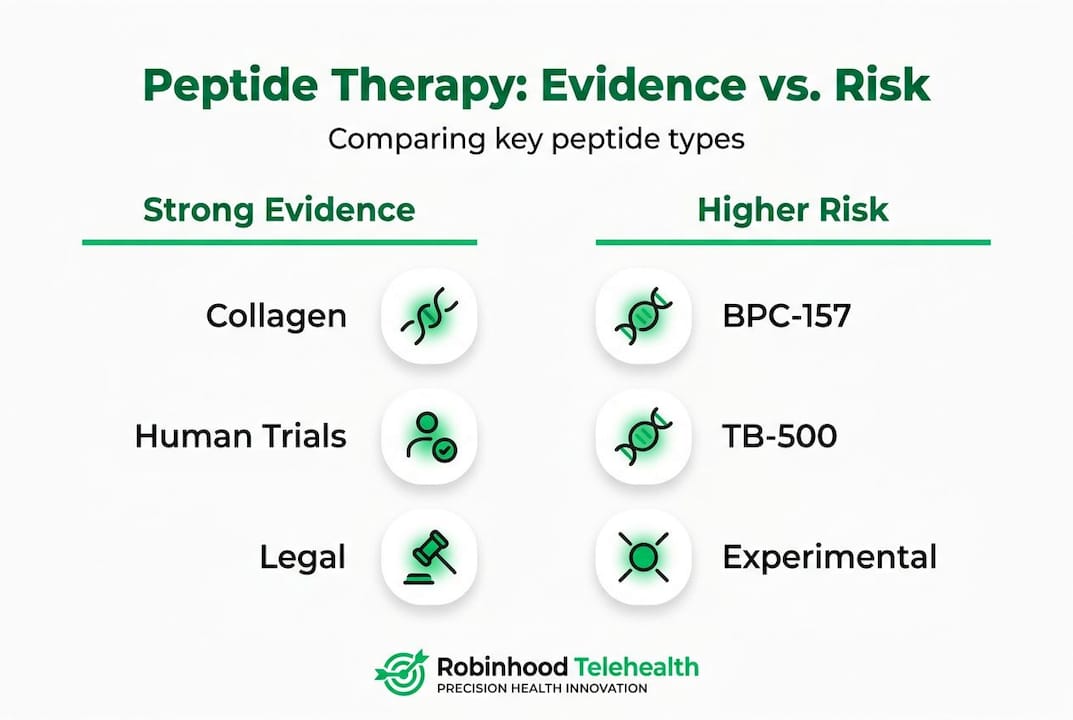
Critical warning: BPC-157 and TB-500 are banned by WADA, and unregulated online sources carry serious risks of contamination, inaccurate dosing, and unknown long-term safety consequences. Buying from gray-market suppliers is not just risky from a rules standpoint; it is genuinely dangerous.
Here is what every athlete needs to understand about safety and legality:
- WADA banned status: BPC-157 and TB-500 are explicitly prohibited for athletes subject to anti-doping rules. A positive test result means suspension, disqualification, and potentially career-ending consequences. This is not a gray area.
- Contamination risk: Peptides purchased from unregulated online vendors are frequently mislabeled, underdosed, overdosed, or contaminated with bacteria and other compounds. Independent lab testing of gray-market peptides has repeatedly found alarming inconsistencies.
- Injection risks: Most of the higher-potency peptides require subcutaneous or intramuscular injection. Without proper sterile technique and clinical guidance, infection risk is real and can be serious.
- Unknown long-term effects: Because controlled human trials are absent for most of these compounds, nobody actually knows what chronic use looks like in terms of long-term organ function, cancer risk, or hormonal disruption. That uncertainty is not trivial.
- Legal access routes: In the United States, some peptides can be obtained legally through compounding pharmacies with a clinician's prescription. This route ensures pharmaceutical-grade quality, proper dosing, and medical oversight. It is the only approach that makes sense from a safety standpoint.
The foundation of safe peptide use rests on clinician involvement, regulated sourcing, and evidence-informed protocols. Resources on safe peptide protocols can help you understand what appropriate oversight actually looks like before you commit to anything.
Integrating peptides with evidence-based recovery strategies
Here is where athletes tend to make their most expensive mistake: treating peptides as the primary strategy rather than a potential addition to a strong recovery foundation.
The current expert consensus in sports medicine is clear: the evidence is insufficient for routine clinical recommendation, and demanding randomized controlled trials before widespread use is entirely justified. That doesn't mean peptides have no future in this space. It means they are not ready to replace what actually works.
A stepwise integration approach:
-
Establish your recovery foundation first. Sleep 7 to 9 hours per night consistently, achieve protein targets of 1.6 to 2.2 grams per kilogram of bodyweight, and complete structured physical therapy and recovery protocols for any musculoskeletal injury. These interventions have overwhelming evidence behind them.
-
Nail your nutrition timing. Pre-workout collagen with vitamin C is supported by actual RCT data for connective tissue health. Protein distribution across meals matters for muscle protein synthesis. Get these right before adding anything else.
-
Address sleep and stress systematically. Cortisol chronically impairs recovery at the cellular level. No peptide overcomes a broken sleep schedule or unmanaged psychological stress. Period.
-
Consult a clinician who understands performance science. If you have done steps 1 through 3 and still have a specific, stubborn injury or recovery challenge, then and only then is it worth a professional conversation about whether a peptide protocol makes sense for your situation.
-
Use only regulated, clinician-prescribed sources. If a clinician does recommend a peptide for off-label therapeutic use, ensure it comes from a licensed compounding pharmacy with batch testing.
| Recovery priority | Evidence strength | Action |
|---|---|---|
| Sleep optimization | Very strong | 7 to 9 hours, consistent schedule |
| Protein intake and timing | Very strong | 1.6 to 2.2g per kg daily |
| Structured rehabilitation | Strong | Program with a physical therapist |
| Collagen peptides plus vitamin C | Moderate | 15g collagen 30 to 60 min pre-exercise |
| GH secretagogues | Low to moderate | Clinician oversight only |
| BPC-157 or TB-500 | Very low | Experimental, clinician oversight only |
Pro Tip: Think of peptides as the final 5% optimization layer, not the foundation. Athletes who see the best results use them on top of an already excellent recovery program, never instead of one.
What most athletes get wrong about peptides for recovery
Here is a perspective that most peptide content won't give you: the athletes who benefit most from peptide therapy are the ones who need it the least in terms of their lifestyle, because they already have everything else dialed in.
There's a seductive logic to the peptide shortcut narrative. You're injured, you're frustrated with the slow pace of healing, and suddenly there's a compound that allegedly fixes tendons in weeks instead of months. It makes emotional sense. But the recovery science tells a different story. The athletes who report the strongest results from compounds like BPC-157 are almost always simultaneously doing the rehabilitation, eating the nutrition, and logging the sleep hours that independently produce most of the recovery benefit. Separating the peptide effect from those confounders is genuinely difficult.
What's actually happening in many cases is a combination of proper programming doing the heavy lifting while the peptide gets the credit. This isn't to say peptides are useless. It's to say that your expectations need to be calibrated by the evidence, not by Instagram testimonials from athletes whose full protocols you never see.
The most productive mindset is radical patience combined with systematic progress. Safe peptide use advice consistently emphasizes that peptides work best as precision additions to an already functional system, not as rescue interventions for poorly managed recovery.
Be skeptical of anyone who tells you a peptide will work regardless of what else you're doing. Be even more skeptical of unregulated online vendors who profit from your urgency. The athletes who make the best long-term progress are the ones who treat recovery with the same disciplined patience they apply to training.
Explore safe, science-backed peptide options with professional support
You've done the work of understanding the science. Now the practical question is how to move forward responsibly if peptides make sense for your situation.

Robinhood Telehealth connects athletes directly with clinicians who specialize in performance-focused peptide protocols, sourced from regulated pharmacies and designed around your specific physiology, training demands, and recovery goals. Instead of navigating gray-market risk alone, you get expert evaluation, ongoing monitoring, and personalized guidance that treats peptide therapy as one part of a complete optimization strategy. Explore premium peptide therapy options with the clinical oversight that turns experimental potential into measurable, safe results.
Frequently asked questions
Are peptides safe for athletic recovery?
Some peptides show real promise, but most lack long-term human safety data and carry significant risks when sourced from unregulated suppliers or used without medical oversight.
Which peptide has the most evidence for muscle recovery?
Collagen peptides have the strongest clinical evidence, with RCTs showing improvements in muscle strength and body composition when combined with resistance training.
Are peptides like BPC-157 and TB-500 allowed in sport?
No. Both BPC-157 and TB-500 are banned by WADA for athletes competing under anti-doping regulations, and a positive test carries serious consequences.
How should peptides fit into a recovery plan?
Treat peptides as an optional addition to a foundation of sleep, nutrition, and structured rehab, and only use them under clinician guidance because current evidence is insufficient for routine recommendation in sports medicine.