

Most people have tried at least one diet that looked perfect on paper and delivered almost nothing in practice. That gap between generic advice and your actual results is exactly what a solid personalized nutrition planning guide is designed to close. Your body responds to food differently based on your metabolism, stress load, sleep quality, gut health, and dozens of other factors no one-size-fits-all plan accounts for. This guide walks you through every stage of building a tailored diet plan that works with your biology, your schedule, and your real goals.
Table of Contents
- Key takeaways
- Your personalized nutrition planning guide starts here
- Assessing your current habits and baseline
- Designing targeted, actionable nutrition habits
- Creating a flexible daily nutrition framework
- Tracking, reflecting, and adjusting your plan
- My honest take on personalized nutrition
- How Robinhoodtelehealth takes your plan further
- FAQ
Key takeaways
| Point | Details |
|---|---|
| Start with one clear goal | Choosing a single health priority sharpens your focus and prevents scattered, ineffective changes. |
| Assess your baseline first | Knowing where you are now makes progress measurable and prevents unnecessary dietary overhauls. |
| Build 2-3 specific habits | Small, precise habits outperform total diet overhauls for both adherence and long-term results. |
| Use flexible meal templates | Rigid meal plans break down fast; adaptable frameworks are what actually stick over months. |
| Treat the plan as a loop | Track, reflect, and adjust every few weeks to keep the plan working as your needs evolve. |
Your personalized nutrition planning guide starts here
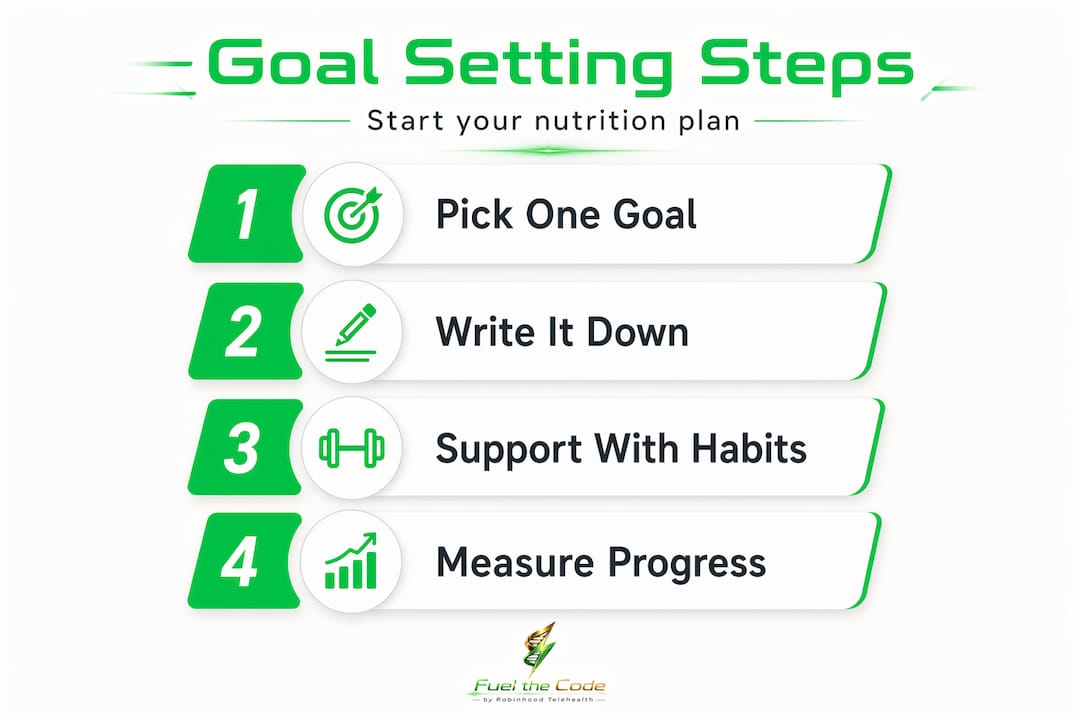
The most consistent mistake people make before building a nutrition strategy guide is skipping the goal-setting step entirely. They collect recipes, buy supplements, and download apps before they have any clarity on what they are actually trying to change.
Choosing one top nutrition priority before adjusting your diet prevents the confusion and diluted progress that comes from chasing multiple goals at once. This is not just motivational advice. When your food choices are evaluated against a single, clear target, every decision becomes simpler.
Common goals worth building a plan around include:
- Gut health: Reducing bloating, improving digestion, or increasing microbial diversity through targeted food choices
- Sustained energy: Stabilizing blood sugar and avoiding the afternoon crashes driven by poor meal timing or refined carbs
- Inflammation reduction: Shifting toward an anti-inflammatory food pattern to support recovery and joint health
- Athletic performance: Timing carbohydrates and protein strategically to fuel training and accelerate repair
- Metabolic health: Improving insulin sensitivity or managing weight through macronutrient structure
Pick one. Write it down. Everything else in your plan becomes a supporting structure for that single priority.
Pro Tip: Frame your goal as a measurable outcome rather than a behavior. "I want more energy in the afternoon" is cleaner than "I want to eat healthier." You can actually test the first one.
Assessing your current habits and baseline
Before you redesign anything, you need to know what you are starting with. Skipping this step is like trying to navigate without knowing your current location.
A useful baseline captures more than what you eat. It also tracks how you feel, how your energy moves through the day, and what your body is telling you through symptoms. Detailed intake info on goals, preferences, lifestyle, and allergies is more impactful for practical personalization than lab tests alone.

Here is what to record during a one-week baseline audit:
| Category | What to track | Why it matters |
|---|---|---|
| Food intake | Meals, snacks, beverages, portions | Reveals patterns, gaps, and excesses |
| Energy levels | Morning, midday, evening on a 1-10 scale | Shows how food timing affects your output |
| Digestive symptoms | Bloating, discomfort, frequency | Points toward food sensitivities or fiber gaps |
| Sleep quality | Duration and how rested you feel | Sleep and nutrition are tightly connected |
| Mood and focus | Mental clarity and emotional stability | Reflects blood sugar regulation and nutrient status |
Once you have this data, consider adding bloodwork if accessible. Markers like fasting glucose, ferritin, vitamin D, CRP, and a lipid panel give you a biochemical snapshot that food journaling cannot provide. A clinician can help interpret these results in the context of your goals.
Pro Tip: Treat your baseline week like a documentary, not a performance. Eat the way you actually eat, not the way you think you should. The more honest the data, the more useful the plan.
Designing targeted, actionable nutrition habits
Most people who "overhaul their diet" last about two weeks. The reason is not a lack of willpower. It is that they changed everything at once and created a system that is impossible to maintain alongside a real life.
The smarter approach is choosing 2-3 specific, measurable habits that directly support your primary goal. Each habit should be concrete enough that you know at the end of the day whether you did it or not.
Here are examples of precisely framed habits organized by goal:
-
For gut health: Eat one cup of leafy greens at lunch every weekday. Add one fermented food (yogurt, kimchi, or kefir) daily. Dietary fiber and fermented foods are among the strongest dietary drivers of microbial diversity.
-
For sustained energy: Eat a protein-rich breakfast within 60 minutes of waking. Avoid refined carbohydrates as standalone snacks. Limit caffeine to the first half of the day.
-
For athletic performance: Consume a carbohydrate and protein combination within 45 minutes post-training. Hit a daily protein target based on body weight (typically 0.7 to 1.0 gram per pound).
-
For inflammation reduction: Replace refined seed oils with olive oil in all home cooking. Add omega-3-rich fish twice per week. Reduce added sugar to under 25 grams daily.
-
For metabolic health: Front-load calories earlier in the day. Pair every carbohydrate source with protein or fat. Walk for 10 minutes after dinner.
Notice how each habit is specific, tied to a timeframe, and measurable. "Eat more vegetables" is not a habit. "One cup of leafy greens at lunch" is.
Pro Tip: If a new habit feels difficult in week one, that is expected. If it still feels like a battle in week four, the habit is probably the wrong fit for your lifestyle, not a sign of personal failure. Adjust the structure, not your self-assessment.
Creating a flexible daily nutrition framework
Rigid meal plans have a clear appeal: someone else makes the decisions. The problem is they collapse the moment your schedule changes, you travel, or you just do not want salmon on a Tuesday for the third week in a row.
A flexible framework solves this by giving you a structure without locking in specifics. You are planning the shape of your eating day, not every bite.
Here is what a flexible framework looks like in practice:
- Template, not prescription: Define meal timing and rough macronutrient targets rather than fixed recipes. "Lunch = protein source + non-starchy vegetables + healthy fat" covers hundreds of meals.
- Carb timing for athletes: If performance is your goal, prioritize carbohydrates before and after training windows rather than eliminating them, then reduce them in lower activity periods.
- Blood sugar balance: For metabolic and energy goals, every meal should include protein, fat, and fiber together. This pattern alone can significantly steady energy levels throughout the day.
- Batch cooking anchor meals: Prepare two or three simple base components each week (roasted vegetables, a protein, a grain) and mix them into varied combinations daily. This reduces decision fatigue without creating meal-plan monotony.
The goal of any individualized meal planning framework is to make the default choice the right one. When your kitchen and schedule already support your goal, willpower is not the deciding factor.
Tracking, reflecting, and adjusting your plan
Personalized nutrition is not a document you finalize and follow forever. It is a learning loop. The sequence is straightforward: track what you do, reflect on what changed, adjust based on evidence.
-
Track for two to four weeks. Log meals, energy, symptoms, and any relevant biometrics. You do not need a sophisticated app. A notes file on your phone works fine as long as you are consistent.
-
Reflect on what the data shows. Are you hitting your habits most days? Has your primary goal symptom improved? Where are the patterns breaking down?
-
Adjust one variable at a time. If energy is still inconsistent, try adding protein at breakfast before changing anything else. Changing multiple things simultaneously makes it impossible to know what actually helped.
-
Validate in short windows. Behavior shifts and measurable outcomes can often be detected within one month of consistent, tailored dietary changes. You do not need six months to know if a habit is working.
-
Loop back and reset. Once a habit becomes automatic and your primary goal improves, you can layer in a new priority or refine your framework further.
Pro Tip: Take a weekly photo of your meal log and your energy ratings side by side. Visual patterns you would never spot in daily notes become obvious when you see two weeks at once.
"Personalization works best as a learning system cycling through setting priorities, measuring responses, and adjusting. It is not a one-time configuration."
On the advanced end, tools like DNA-based nutrigenetics, methylation testing, and gut microbiome analysis can add depth to this process. A 2026 study showed 71% adherence and increased microbiome diversity after one month using a platform that integrated biomarkers with personalized dietary advice. That said, long-term clinical evidence for microbiome-based personalization remains limited. These tools work best as supplements to strong behavioral foundations, not replacements for them.
Choosing supplements safely within a personalized plan also requires clinical confirmation of actual need, not just marketing copy. Get tested before you stack.
My honest take on personalized nutrition
I have worked with enough people on their nutrition to know that the biggest obstacle is rarely knowledge. It is the belief that personalization means complexity.
In my experience, the clients who get the best results are the ones who resist the urge to do everything at once. They pick one goal, build two habits around it, and stay curious about the feedback their body sends back. That sounds almost too simple, and that is exactly why most people skip it.
What I have also seen: people who invest in microbiome kits or genetic tests before they have stable eating habits get very little useful information. The data is only as actionable as the behavior underneath it. Overconfidence in microbiome personalization is a real pitfall. The science is promising, but it needs a behavioral foundation to translate into anything meaningful.
The flexible framework approach changed how I think about meal planning entirely. When you stop trying to control every meal and instead design a structure that makes good choices easy, adherence stops being a willpower question. It becomes an environment question.
The most useful thing you can do right now is spend one week tracking honestly before changing a single thing. What you find will tell you more than any quiz, app, or algorithm.
— G
How Robinhoodtelehealth takes your plan further
Building your own personalized meal guide using this framework is a strong starting point. But if you want to skip the guesswork and use your actual biology to drive decisions, Robinhoodtelehealth has the infrastructure to make that happen. Their DNA-based performance profile uses genetic fitness testing to identify how your body responds to macronutrients, training types, and recovery demands. This is the difference between a plan built on general principles and one built on your data.
If you suspect methylation, hormone balance, or metabolic function is the underlying issue, their at-home methylation kit adds another layer of precision. Clinician-guided peptide and GLP-1 protocols are also available for those with specific metabolic or body composition goals. Start with a free consultation to map out which approach fits where you are right now.
FAQ
What is the first step in personalized nutrition planning?
The first step is selecting a single, specific health or performance goal. Choosing one main priority before adjusting your diet prevents confusion and keeps your food choices focused and measurable.
How long does it take to see results from a personalized diet plan?
Research shows measurable behavior and health changes can occur within one month when a personalized plan is followed consistently. Results vary based on the goal, starting point, and adherence.
Do I need genetic testing to personalize my nutrition?
No. Structured data on goals, preferences, and lifestyle is more immediately useful than lab tests for most people starting out. Genetic and biomarker testing adds depth once strong behavioral habits are in place.
How do I know when to adjust my nutrition plan?
Review your tracking data every two to four weeks. If your primary goal symptom has not shifted and you have been consistent with your habits, adjust one variable (such as meal timing or protein intake) and observe the response before changing anything else.
Are supplements necessary for a personalized nutrition plan?
Only when clinical testing confirms a specific deficiency or need. Choosing supplements safely requires verification of actual need and awareness of potential interactions with medications or existing conditions.