

Nutrigenomics, the science of using genetic data to guide dietary choices, is the foundation of how to create DNA-based meal plans that go beyond generic calorie counting. Your DNA contains variants in genes like APOA5, FTO, LCT, and MTHFR that directly influence how your body processes fats, carbohydrates, and key micronutrients. By translating those variants into macro targets and food category rules, you build a personalized nutrition plan grounded in your biology rather than population averages. Robinhoodtelehealth combines genetic testing with AI-driven meal planning to make this process practical and clinician-supported.
How to create DNA-based meal plans: what you need first
Before you build a single meal template, you need two things: a genetic test that covers nutrition-relevant markers, and a clear framework for interpreting what those markers mean.

Choosing the right genetic test
Single nucleotide polymorphism (SNP) panels from nutrigenomics providers analyze hundreds of gene variants tied to metabolism, inflammation, and nutrient absorption. The markers that matter most for meal planning include FTO (appetite regulation and fat storage), APOA5 (triglyceride metabolism and fat tolerance), LCT (lactase persistence and dairy digestion), and MTHFR (folate metabolism and methylation). Some platforms convert a cheek swab into nutrient tolerance tags that feed directly into a nutrigenomics engine, producing grocery lists and printable plans within 48 hours. That speed matters because the faster you move from data to action, the higher your adherence.
Tools and data inputs you need before starting
| Tool type | Function |
|---|---|
| SNP nutrigenomics panel | Identifies gene variants affecting fat, carb, and protein metabolism |
| Nutrigenomic interpretation app | Converts raw SNP data into food category flags and macro guidance |
| Lifestyle intake form | Captures diet preferences, cooking time, budget, and health goals |
| Meal planning platform | Generates calendar-based meal templates and grocery lists |
| Clinician or registered dietitian | Validates genetic findings against current health status and labs |
Your lifestyle data is not optional. Goals, preferences, and budget are prioritized by nutrition experts over genetics alone when it comes to real-world adherence. Genetics tells you what your body prefers. Your preferences tell you what you will actually eat.
How to translate genetic results into macro targets and food categories
The most common mistake in genetic nutrition is treating SNP flags as direct calorie targets. They are not. Turning SNP flags into food-category priorities is more practical than direct calorie targeting, and macro ratios should align with conventional nutrition goals while accounting for genetic predispositions.
Understanding metabolic levers
A metabolic lever is a genetic predisposition that meaningfully shifts how your body handles a macronutrient. If you carry the APOA5 risk variant, your body clears dietary fat from the bloodstream more slowly, making a lower-fat macro split a logical starting point. If your FTO variant is associated with reduced satiety signaling, higher protein intake becomes a lever for appetite control. Identifying your primary metabolic levers from genetic results is the first step, followed by setting macro targets like 40% protein, 35% fat, and 25% carbohydrate, then mapping those targets to food categories and meal structures.
Macro setups by genotype: a comparison
| Genotype profile | Suggested macro ratio | Key food category focus |
|---|---|---|
| High fat sensitivity (APOA5 risk) | 30% fat / 40% protein / 30% carb | Lean proteins, legumes, low-fat dairy |
| Low carb tolerance (FTO risk) | 35% fat / 35% protein / 30% carb | Non-starchy vegetables, quality fats, moderate grains |
| Lactase non-persistent (LCT) | Standard macros, dairy-free | Plant milks, leafy greens, fortified foods |
| MTHFR C677T variant | Standard macros, folate-rich | Dark leafy greens, legumes, methylated B-vitamin sources |
Pro Tip: Never build a food "avoid" list based on a single SNP. Genetic flags indicate tendencies, not certainties. Cross-reference each flag with your current bloodwork and dietary history before removing an entire food category.
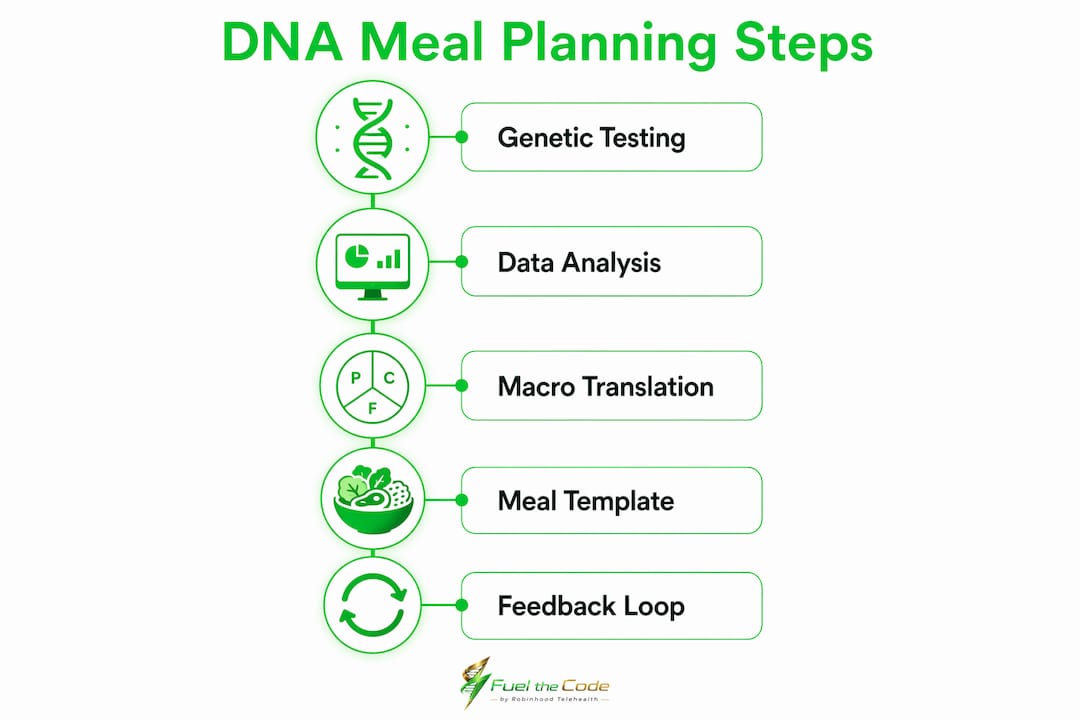
Step-by-step meal planning: building your DNA-based templates
Translating macro targets into daily meals requires a repeatable structure. The following process converts your genetic data into a working weekly plan.
-
Set your daily macro targets. Use your genotype profile to establish gram-level protein, fat, and carbohydrate targets for your calorie goal. A 2,000-calorie plan with a 40/30/30 split means 200g protein, 67g fat, and 150g carbohydrates daily.
-
Assign macro anchors to each meal. Breakfast carries the highest protein load for appetite control, particularly if your FTO variant reduces satiety. Lunch balances protein and complex carbohydrates. Dinner centers on lean protein and non-starchy vegetables.
-
Build food category lists from your genetic flags. Your "include" list contains foods that align with your metabolic levers. Your "limit" list contains foods that conflict with flagged variants. These lists become your shopping and recipe filters.
-
Create three to five base meal templates per slot. Rotating templates prevent monotony without requiring daily decision-making. A high-protein breakfast template might include eggs, Greek yogurt, and berries. A lean-protein dinner template might include salmon, roasted broccoli, and quinoa.
-
Generate a weekly grocery list from your templates. Batch cooking and printable grocery lists reduce decision fatigue and improve long-term success beyond genetic interpretation alone. Group items by store section to cut shopping time.
-
Load your plan into a meal planning app. Platforms with calendar views, ingredient substitution features, and recipe links make the plan usable day to day. Robinhoodtelehealth's AI-driven meal planning process integrates these features with your genetic profile.
-
Review and adjust after two weeks. Track energy, digestion, and satiety. If a macro ratio is not working in practice, adjust it. Genetics sets the starting point. Your lived experience refines it.
Pro Tip: Batch cook two proteins and two carbohydrate sources every Sunday. Label containers with the macro content per serving. This single habit removes the biggest daily friction point in any personalized nutrition plan.
Common challenges and how to optimize adherence
Genetic data alone does not change behavior. A 2025 trial found that genetic risk notifications increased physical activity but did not improve diet without additional counseling and behavioral support. That finding reframes the entire DNA meal planning process. The plan is not the product. The support system around the plan is.
The most common adherence failures in genetic-based diets are predictable and fixable:
- Overcomplicating the food list. Restricting too many categories based on minor SNP flags creates a plan that is nutritionally sound but practically impossible. Limit hard restrictions to variants with strong evidence, like LCT for lactose intolerance or HLA-DQ2/DQ8 for gluten sensitivity.
- Ignoring taste and culture. A plan that excludes foods central to your cultural identity will fail within weeks. Genetic nutrition guidance must work within your food preferences, not against them.
- Skipping the feedback loop. Combining nutrigenetics with lifestyle data into a platform generates calendar meal plans with recipe links and grocery products, and studies show 70% of participants adopted recommendations after one month when usability features were present.
- Treating the plan as permanent. Your body changes. Your goals change. A DNA-based meal plan built in 2026 should be reviewed every three to six months against current labs and health markers.
- Going without support. Coupling genetic insights with registered dietitian counseling or a telehealth coaching program produces measurably better outcomes than self-directed interpretation alone.
The personalized meal plans that succeed long-term treat genetics as one input in a larger system that includes behavior, preference, and clinical oversight.
What the evidence actually says about DNA-based meal plans
DNA-based meal planning is scientifically grounded in some areas and genuinely overpromised in others. Knowing the difference protects you from wasting money and sets realistic expectations.
The clearest wins are in well-characterized gene-diet interactions. Lactose intolerance linked to LCT variants, celiac disease risk from HLA typing, and folate metabolism disruption from MTHFR C677T are clearly actionable genetic findings with strong clinical evidence. For most other SNPs in commercial panels, the evidence is associative rather than causal, meaning the variant correlates with a tendency but does not determine an outcome.
On the regulatory side, FDA oversight of genetic tests depends heavily on claim type. Wellness claims face lighter scrutiny than diagnostic or health risk claims, which require FDA clearance. This means a product marketed as a "wellness nutrition guide" based on your DNA operates under different standards than a clinical diagnostic tool. Read the fine print on any genetic nutrition product you purchase.
"The most defensible use of genetic nutrition data is as a hypothesis generator, not a prescription. Use it to form a starting point, then let your body's response be the evidence."
Pro Tip: When evaluating any DNA diet product, ask two questions: Which specific gene variants does this test analyze? What peer-reviewed evidence links those variants to the dietary recommendations provided? If the company cannot answer both clearly, treat the results as directional, not definitive.
Key takeaways
DNA-based meal planning works best when genetics serves as a starting framework, refined continuously by real-world feedback and behavioral support.
| Point | Details |
|---|---|
| Start with metabolic levers | Identify your top genetic predispositions before setting any macro targets. |
| Convert SNPs to food categories | Translate genetic flags into include and limit food lists, not direct calorie rules. |
| Build repeatable templates | Use three to five rotating meal templates per slot to reduce daily decision fatigue. |
| Add behavioral support | Pair genetic insights with counseling or coaching to drive actual dietary change. |
| Verify with evidence | Prioritize actionable variants like LCT and MTHFR over speculative SNP associations. |
Genetics is a starting point, not a verdict
I have spent years watching people approach genetic nutrition with one of two attitudes: either they treat their DNA results as an oracle, or they dismiss the whole category as marketing. Both positions miss the point.
What I have found actually works is treating your genetic data the way a good mechanic treats a diagnostic readout. It tells you where to look first. It does not tell you what the final repair will be. The FTO variant that suggests reduced satiety signaling does not mean you are destined to overeat. It means your meal structure should probably front-load protein and fiber to compensate for a biological tendency. That is a useful, specific, and actionable insight. It is also just the beginning.
The clients who get the most from genetic nutrition are the ones who combine their results with honest tracking, regular lab reviews, and a willingness to adjust. They do not treat their first DNA-based meal plan as the final answer. They treat it as version one. The science of multi-omics, integrating genetics with microbiome data and metabolic markers, is moving fast. What we can do with genetic nutrition data in 2026 is genuinely more useful than it was five years ago. But the fundamentals have not changed. Eat mostly whole foods, prioritize protein, manage your energy balance, and use your genetic data to sharpen the edges of that foundation rather than replace it.
— G
How Robinhoodtelehealth supports your DNA nutrition journey

Robinhoodtelehealth's Genetic Fitness Testing provides a DNA-based performance and nutrition profile that identifies your key metabolic markers, macro predispositions, and nutrient sensitivities for $349. The platform pairs those results with AI-driven meal planning, personalized grocery lists, and clinician-guided protocols so your genetic data translates directly into a working daily plan. For readers who want to go deeper, methylation testing adds another layer of precision by revealing how your body processes folate, B vitamins, and cellular repair pathways. Robinhoodtelehealth positions genetic testing not as a standalone product but as the entry point to a full precision wellness system backed by licensed practitioners.
FAQ
What genes are most relevant for DNA-based meal planning?
The most actionable genes for nutrition include FTO (appetite and fat storage), APOA5 (triglyceride metabolism), LCT (lactose digestion), and MTHFR (folate and methylation). These variants have the strongest clinical evidence linking them to specific dietary adjustments.
How accurate are DNA-based diet recommendations?
Accuracy varies by gene variant. Interactions like lactose intolerance and celiac risk typing are well-supported by clinical evidence, while most commercial SNP panels offer associative rather than causal guidance. Use results as a starting framework and refine based on your body's actual response.
How long does it take to get results from a DNA nutrition test?
Most direct-to-consumer nutrigenomics platforms deliver results within 48 hours to three weeks depending on the test type. Platforms that convert saliva samples into nutrient tolerance tags and meal plan outputs often deliver faster turnaround than clinical panels.
Do I need a dietitian to use a DNA-based meal plan?
A registered dietitian or telehealth clinician is not required but significantly improves outcomes. A 2025 trial confirmed that genetic risk information alone did not change diet without behavioral support, making professional guidance a meaningful investment for anyone serious about long-term results.
Can DNA-based meal plans work for the whole family?
Yes, with individual customization. Family members share some genetic variants but differ in others, so a shared meal framework built around whole foods and lean proteins can accommodate individual genetic tweaks through portion adjustments and ingredient swaps rather than entirely separate plans.